
Judge presses administration over tree-cutting at Washington golf course as redevelopment fight escalates
Evidence and accountability
Archive transparency: this article has not yet completed the site's newer independent fact-audit process. Its source links are provided below. Do not treat allegations, commentary, or a rating as a legal finding.
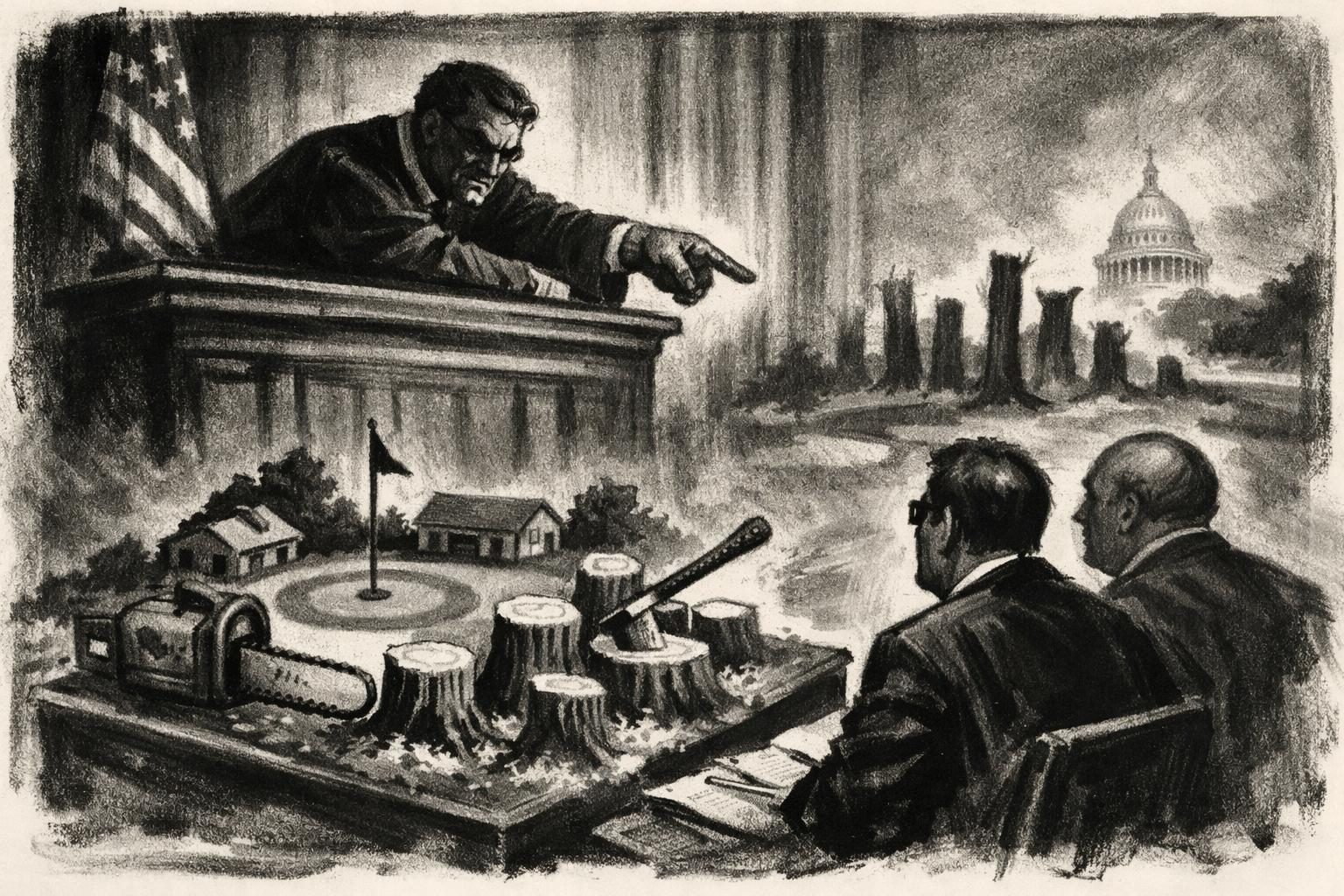
A federal judge spent more than five hours on Monday pressing the Trump administration over its plans to redevelop a historic Washington golf course, in a hearing that repeatedly circled back to one central question: whether the government had already done more on the ground than it was admitting in court. The dispute has become about far more than trees, landscaping, or the aesthetics of a private club. It is now a test of how much room an administration has to move ahead with a politically sensitive project while a judge is actively weighing whether to stop it. The court had already entered a temporary block on the redevelopment, and the judge had made clear that the timing of recent tree-cutting — carried out over a holiday weekend and with limited notice to the plaintiffs — raised serious concerns. By the end of the hearing, there was no immediate ruling, but the proceeding itself underscored how badly the administration’s explanations were being scrutinized. What was supposed to be a debate over whether work could proceed has instead become a debate over whether the project had already been advanced in practice before the court could fully intervene.
The judge’s questions suggested deep skepticism about the administration’s position that the tree removal did not amount to a meaningful step toward redevelopment. On paper, the government has argued that what happened on the property should not be treated as proof that the larger project was effectively underway. In the courtroom, though, that distinction seemed to be under severe strain. The hearing appeared to focus not only on the physical changes to the course, but also on the sequence of events: when the work began, how much notice was given, and whether the government had taken adequate care to avoid making irreversible changes while the legal fight was still pending. That matters because courts tend to pay close attention when a party may be trying to create facts on the ground before the law has had its say. If a judge concludes that a litigant is attempting to sidestep an order, even indirectly, it can color the entire case and make later explanations sound less credible. The administration’s challenge now is not just to defend the underlying redevelopment, but to convince the court that its conduct did not amount to an end-run around judicial control.
The underlying controversy also reflects a larger clash between legal process and political momentum. Supporters of the project may frame it as a redevelopment effort tied to heritage, public interest, or stewardship of a historic site, but those arguments can lose force quickly if the government appears to be acting first and litigating later. That was the dynamic the judge seemed to be probing: whether the administration had been transparent about the scope of its actions, or whether the tree-cutting was effectively a step toward a project that had not yet survived judicial review. For the plaintiffs, the sequence creates a simple and damaging narrative. The government moved rapidly, altered the property, and then asked the court to treat the changes as legally insignificant. Judges are often wary of that posture because it risks making court orders meaningless in practice, even if they remain intact on paper. The result is a case that is no longer only about one piece of real estate in Washington; it is about whether executive power can be used to accelerate a controversial project before the courts can fully assess its legality. The administration may still believe it has legal arguments on its side, but Monday’s hearing made clear that those arguments will be heard through the filter of substantial judicial suspicion.
The broader significance lies in the way the hearing exposed the consequences of moving too quickly in a case with obvious political and historical sensitivity. Even without a fresh order from the bench, the government left court facing a record shaped by the judge’s concerns and by the possibility that the tree-cutting had already changed the factual landscape in ways that cannot easily be undone. That is a dangerous place for any litigant, especially one that is already being accused of showing too little respect for judicial limits. If the court becomes convinced that the administration acted before fully securing legal permission, the judge could impose tighter restrictions, demand closer supervision, or take a more skeptical view of the government’s future claims. The hearing also signals that this fight may reach beyond the golf course itself, since the same concerns about transparency, timing, and compliance could invite broader scrutiny of how the administration handles contested development and preservation disputes. For now, the immediate damage is reputational and procedural rather than final, but that can still matter a great deal. In open court, the administration was forced to defend not only a project, but a method, and the method looked to the judge like a classic attempt to outpace the law.
Comments
Threaded replies, voting, and reports are live. New users still go through screening on their first approved comments.
Log in to comment
No comments yet. Be the first reasonably on-topic person here.