
Judge blocks DHS election operations in nine states
Permanent article number: 102426007 Find another article by number
Original reporting and source documents
Open the reporting and original documents used for this article. These include evidence sources; not every link is necessarily the original claim being examined.
Evidence and accountability
Accountable person, organization or policy: Trump administration / DHS
Documented issue under review: A federal court temporarily blocked the administration’s election-related field operations and interviews in nine states, indicating a substantial legal problem with the initiative as implemented.
This report has an independent editorial fact-audit recorded in the archive. Check the linked source documents below for the underlying evidence; where a case remains pending, allegations are not findings.
Questions sent by Radical Reading Room
These requests have a recorded outbound message ID and send time. A request for comment does not establish that its recipient read the message.
Department of Homeland Security (DHS) — Public professional press contact
Question: What specific operational methods and data practices did DHS and ICE implement in the election-related field activities that were halted by the injunction?
Contacted: October 25, 2026 at 1:24 PM (server time).
Status: Response pending; no substantive response recorded.
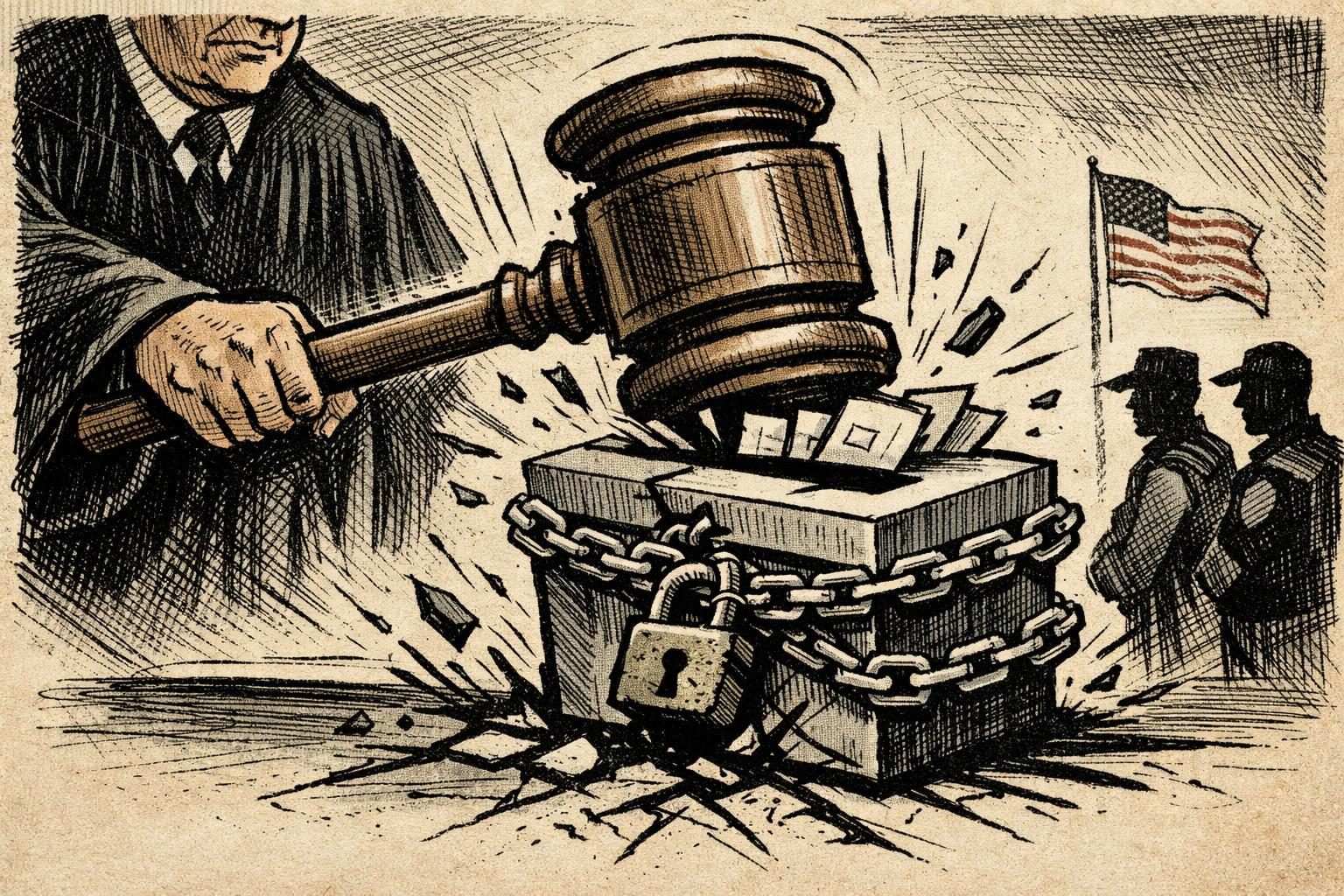
A federal judge has temporarily halted a tranche of Department of Homeland Security election-related field activity in nine states, giving the Trump administration a sharp legal setback as its voter-fraud and election-integrity push continues to face scrutiny in court. The order does not decide the underlying dispute on the merits, and it does not amount to a finding that DHS committed wrongdoing. What it does do is impose an immediate judicial limit on how the department and Immigration and Customs Enforcement may carry out specified operations tied to the administration’s election-security effort. For the moment, that means the government cannot press ahead with the covered activities while the case proceeds. In practical terms, the ruling narrows an initiative that was presented by the administration as a law-enforcement measure, but which challengers say risked sweeping in U.S. citizens and chilling lawful participation in elections.
The controversy centers on what the administration has described as a campaign to protect the vote from noncitizen interference, and on the methods DHS used to pursue that goal. According to the court record reflected in the filed papers and the injunction itself, the challenged program involved internal guidance for field operations in California, Connecticut, Georgia, Missouri, Nevada, New York, Pennsylvania, Washington, and Wisconsin. The plaintiffs argued that the plan crossed a line from ordinary election enforcement into intrusive interviews and investigative steps aimed at people who could be U.S. citizens. That claim mattered to the judge not because political rhetoric about election integrity is unusual, but because the operational design alleged in the lawsuit raised a concrete constitutional and administrative-law question about whether the government had authority to proceed in that manner. The court’s intervention suggests the challengers showed enough legal risk to justify emergency relief while the case is litigated. It does not settle the broader policy debate over election integrity, but it does force the administration to pause the specific tactics at issue in those nine states.
The order is especially significant because it is a concrete restraint on executive action rather than a symbolic rebuke. A preliminary injunction generally reflects a court’s view that the plaintiffs have demonstrated some combination of likely success on the merits, potential irreparable harm, and a need to preserve the status quo until the dispute can be fully heard. In this instance, that means the judge found enough concern about the legality and effects of DHS’s election-related field operations to stop them in their covered form. The point of the lawsuit, from the challengers’ perspective, was not merely to object to the administration’s messaging; it was to block an operational scheme they said could deter eligible voters and target people without an adequate basis. The court’s order therefore carries immediate administrative consequences, even if it is only interim. DHS and ICE remain free to defend their policy choices, ask for modification, or pursue an appeal, but they cannot continue the restricted operations as previously planned in the nine named states while the injunction stands.
How the matter has been framed publicly underscores the difference between political spin and legal effect. The White House and DHS have cast the initiative as election-integrity work, presenting it as part of a broader effort to secure the vote and deter noncitizen interference. Supportive commentary has treated the injunction as a blow to anti-fraud enforcement and a setback for the administration’s enforcement posture. But the core record matters more than the competing narratives. The litigation concerns a specific set of field operations and interviews, along with the data practices used to support them, and the injunction reflects a judicial determination that those tactics raised serious enough legal questions to warrant immediate restraint. The most careful reading is that the court temporarily constrained a right-wing administration’s election-policing tactic after finding sufficient cause to intervene. That is not the same as proving the government acted unlawfully, but it is enough to establish that the policy now faces a real and present legal barrier. In accountability terms, the significance lies in the fact that the administration’s approach has already been narrowed by a court order before any final merits ruling has been reached.
For now, the case remains live and unresolved. The administration can continue to defend the initiative, attempt to narrow the injunction, or seek appellate review, and the ultimate legality of the underlying program is still to be decided. Even so, the current posture is important: the DHS election-related operations challenged in California have been blocked in nine states, and the administration must operate under that restriction unless and until a higher court or the same court alters the order. The ruling offers a clear example of how election-related enforcement can run into judicial limits when challengers persuade a court that the government’s methods may sweep too broadly or threaten protected participation. It also places the policy dispute in immediate relief, because the effect is not abstract or theoretical. A federal judge has already forced the Trump DHS to stop the covered operations in California, Connecticut, Georgia, Missouri, Nevada, New York, Pennsylvania, Washington, and Wisconsin, at least for now. That makes the injunction one of the clearest current accountability developments in the administration’s broader election-fraud agenda, and a significant reminder that claims of election security do not exempt the government from legal constraints.
Comments
Read the discussion freely. Posting and voting require a verified member account. Every comment and reply is screened by AI before publication. Clear spam and abuse are blocked; only strongly cleared comments publish automatically, while uncertain drafts wait for moderator review. Civil factual disagreement alone is not grounds for rejection.
Log in to comment or join free to take part.
No comments yet. Be the first reasonably on-topic person here.