
Agriculture Department keeps pressing a Forest Service overhaul after a judge already blocked it
Permanent article number: 102526011 Find another article by number
Original article being examined
Published by: Associated Press
Original reporting and source documents
Open the reporting and original documents used for this article. These include evidence sources; not every link is necessarily the original claim being examined.
Evidence and accountability
Accountable person, organization or policy: Agriculture Secretary Brooke Rollins and the Trump administration
Documented issue under review: The administration says it is continuing a Forest Service overhaul even after a judge blocked the changes, creating a live compliance and governance dispute.
This report has an independent editorial fact-audit recorded in the archive. Check the linked source documents below for the underlying evidence; where a case remains pending, allegations are not findings.
Questions sent by Radical Reading Room
These requests have a recorded outbound message ID and send time. A request for comment does not establish that its recipient read the message.
U.S. Department of Agriculture — Public professional press contact
Question: To what extent has the Agriculture Department implemented any components of the Forest Service reorganization plan since the court injunction was issued?
Contacted: October 25, 2026 at 12:04 PM (server time).
Status: Response pending; no substantive response recorded.
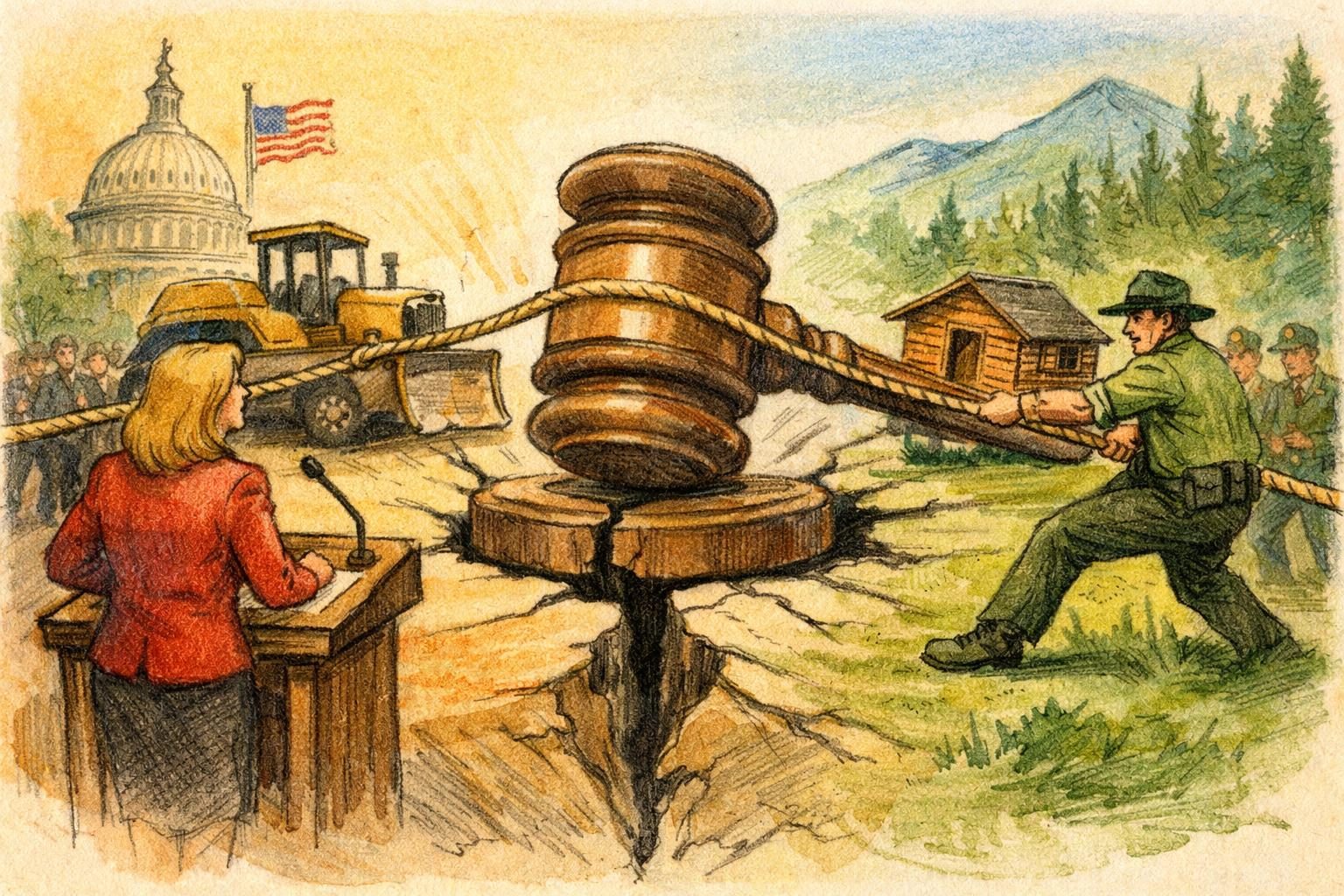
Agriculture Secretary Brooke Rollins said this week that the Trump administration is still pressing ahead with a sweeping overhaul of the Forest Service, even though a federal judge has already put the plan on hold. Speaking on October 22, Rollins said the administration remained “full-bore ahead” with the reorganization of the Forest Service and related agencies, a declaration that sharpened what had already become a dispute over authority, timing and compliance. The broader significance of the remark is not just that the administration wants to continue a personnel and management shake-up, but that it is signaling confidence that it can keep moving while the legal fight plays out. That posture turns an internal agency restructuring into a live test of how an executive branch can act when a court has intervened. The immediate question is no longer whether the reorganization is controversial; it is whether, and to what extent, anything in the plan can proceed while the block remains in place.
According to AP, the plan itself is still stalled under the court order, even as the department projects defiance or at least determination. That tension between the order and the administration’s public messaging is now the center of the story. If the judge has blocked the changes, then any meaningful implementation would have to be carefully limited, delayed, or otherwise adjusted to avoid violating the ruling. At the same time, the department’s insistence that it is continuing “full-bore ahead” suggests the administration either believes portions of the effort are still legally permissible or is trying to maintain momentum despite the injunction. For agency employees and managers, the ambiguity is its own form of disruption. When leaders promise a major overhaul but a court has frozen it, normal decision-making becomes harder, morale can worsen, and planning can be thrown into limbo. That is especially true in a workforce that is already under pressure from reductions and uncertainty about what the agency will look like next.
The administration has portrayed the overhaul as part of a larger effort to make government leaner and more efficient, echoing President Trump’s push to slim the federal workforce. Supporters of that approach are likely to argue that a large, bureaucratic agency benefits from consolidation and fewer layers of management, especially if officials believe the existing structure is slow or inefficient. Critics see the same plan very differently. To them, the reorganization is not a neutral efficiency measure but a destabilizing intervention that could weaken the Forest Service’s ability to carry out its mission, manage lands and respond to urgent demands. AP reported that the Forest Service workforce has already fallen roughly 16% under Trump, a figure that adds practical context to the legal fight and helps explain why the reorganization has drawn so much attention. A shrinking staff combined with a contested restructuring raises obvious questions about capacity, institutional memory and day-to-day operations. Even if the administration says the changes are meant to improve performance, the effect on the ground may be more complicated, especially in an agency that often has to respond to fast-moving and seasonal demands.
This is, at bottom, a governance story rather than a misconduct story. The central accountability issue is not whether the administration has the political power to try to reshape the Forest Service in the first place; it is whether it can do so while respecting a court order that has already blocked the changes. That makes the Agriculture Department under Rollins the key actor, and it makes the legal process as important as the policy itself. The story also stands apart from the broader debate over federal downsizing because it is now bound to a specific judicial constraint. If the administration continues to push forward in ways that conflict with the ruling, the dispute could deepen into a more direct confrontation over compliance. If, instead, the department confines its actions to what the court allows, the reorganization may remain a longer-term project rather than an immediate operational reality. Either way, the episode shows how quickly a management plan can become a court-supervised test of executive restraint, with consequences for both the agency’s workforce and the future shape of the Forest Service.
Comments
Read the discussion freely. Posting and voting require a verified member account. Every comment and reply is screened by AI before publication. Clear spam and abuse are blocked; only strongly cleared comments publish automatically, while uncertain drafts wait for moderator review. Civil factual disagreement alone is not grounds for rejection.
Log in to comment or join free to take part.
No comments yet. Be the first reasonably on-topic person here.