
Trump broadens Defense Production Act use to back petroleum production and refining
Permanent article number: 102526014 Find another article by number
Original reporting and source documents
Open the reporting and original documents used for this article. These include evidence sources; not every link is necessarily the original claim being examined.
Evidence and accountability
Accountable person, organization or policy: Trump White House
Documented issue under review: Used a presidential determination to expand emergency-style federal support for domestic petroleum projects, raising questions about the use of national-security authorities to advance fossil-fuel priorities.
This report has an independent editorial fact-audit recorded in the archive. Check the linked source documents below for the underlying evidence; where a case remains pending, allegations are not findings.
Questions sent by Radical Reading Room
These requests have a recorded outbound message ID and send time. A request for comment does not establish that its recipient read the message.
U.S. Department of Energy — Public professional press contact
Question: Which specific refinery or refineries is the Energy Department targeting for restart or expansion using Defense Production Act funding?
Contacted: October 25, 2026 at 5:54 PM (server time).
Status: Response pending; no substantive response recorded.
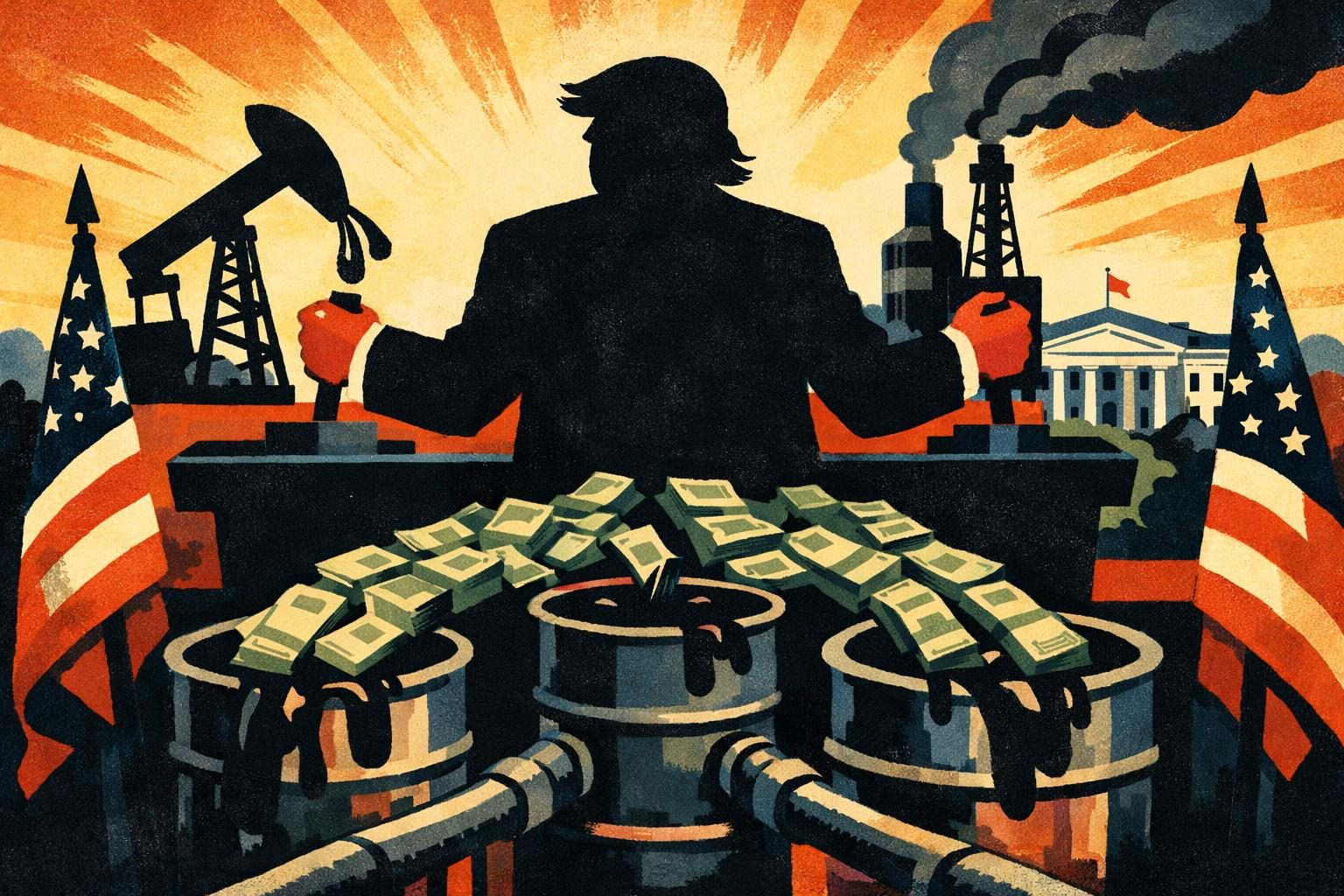
President Donald Trump has broadened the federal government’s use of the Defense Production Act to include domestic petroleum production, refining and logistics capacity, marking a significant expansion of a law historically associated with emergency industrial mobilization. In a presidential determination dated October 22, Trump declared that these parts of the oil system are essential to national defense and moved to waive several procedural requirements that normally shape how the government can deploy DPA authority. The practical effect is to speed up the process for federal backing of projects tied to petroleum output and infrastructure, including support linked to refining and supply-chain capacity. The move is not a symbolic declaration or a recycled campaign line; it is a new policy action with immediate administrative consequences. At a moment when the administration has often cast energy policy in terms of security and resilience, the order gives that framing a more concrete legal form.
The Energy Department moved quickly after the presidential determination, saying it would use Defense Production Act funding to restart an American refinery and expand refining capacity. According to the department, the Trump administration had announced plans to provide up to $150 million for projects tied to production, storage and logistics, signaling that the federal government is preparing to steer money toward fossil-fuel infrastructure under an emergency-style statute. That is an important detail because the DPA is not just a rhetorical tool; it can direct federal resources into specific parts of the industrial economy when officials determine those sectors matter to national defense. The administration’s choice to apply that logic to petroleum production and refining suggests a deliberate effort to treat oil infrastructure as strategically indispensable rather than merely commercially important. It also raises the stakes for how future grant decisions, project approvals and federal support programs may be structured if this interpretation holds.
Reuters independently reported the same development and described it as a potential opening for U.S. funding of fossil-fuel projects, underscoring that the administration’s action is being treated as real and operational rather than aspirational. That independent confirmation matters because it separates the October 22 determination from the usual stream of energy messaging and places it squarely in the category of consequential government action. The administration’s supporters are likely to argue that the measure responds to supply-chain vulnerability, refinery constraints and the need to shore up domestic energy security. From that perspective, bringing petroleum production and refining under the umbrella of national defense could be presented as a practical response to economic and geopolitical uncertainty. But the same move will predictably be read by critics as a dramatic repurposing of wartime-era legal authority in service of the fossil-fuel industry.
The policy choice also carries a broader political and legal meaning because it reveals how the Trump administration is using emergency-style powers to shape industrial priorities. By waiving parts of the normal Defense Production Act process, Trump is making it easier for the federal government to intervene in favor of a specific energy sector while describing that intervention as protection of the national interest. That gives the White House more flexibility to channel support quickly, but it also concentrates more discretion in the executive branch over which industries are treated as essential and which are left out. For supporters, that may look like decisive leadership in a sector viewed as central to transportation, manufacturing and national resilience. For opponents, it looks like an energy power grab that recasts climate and industrial policy through the language of defense while giving fossil-fuel infrastructure a federal assist. Either way, the October 22 determination is a substantive and newly issued action that will likely shape how the administration argues for its energy agenda going forward.
Comments
Read the discussion freely. Posting and voting require a verified member account. Every comment and reply is screened by AI before publication. Clear spam and abuse are blocked; only strongly cleared comments publish automatically, while uncertain drafts wait for moderator review. Civil factual disagreement alone is not grounds for rejection.
Log in to comment or join free to take part.
No comments yet. Be the first reasonably on-topic person here.