
Trump opens a new trade fight over wind turbine imports without imposing tariffs yet
Permanent article number: 102526015 Find another article by number
Original article being examined
Published by: The White House
Claim examined: The president directed trade officials to negotiate over wind turbine imports and may consider further remedies, including tariffs.
Original reporting and source documents
Open the reporting and original documents used for this article. These include evidence sources; not every link is necessarily the original claim being examined.
Evidence and accountability
Accountable person, organization or policy: Trump administration trade policy
Documented issue under review: The administration is expanding tariff-driven trade pressure into another energy sector, with uncertain consumer and industrial costs.
This report has an independent editorial fact-audit recorded in the archive. Check the linked source documents below for the underlying evidence; where a case remains pending, allegations are not findings.
Questions sent by Radical Reading Room
These requests have a recorded outbound message ID and send time. A request for comment does not establish that its recipient read the message.
U.S. Department of Commerce — Public professional press contact
Question: What specific criteria and evidence will the Commerce Department and U.S. Trade Representative use to evaluate wind turbine imports during the 180-day review period?
Contacted: October 25, 2026 at 3:14 PM (server time).
Status: Response pending; no substantive response recorded.
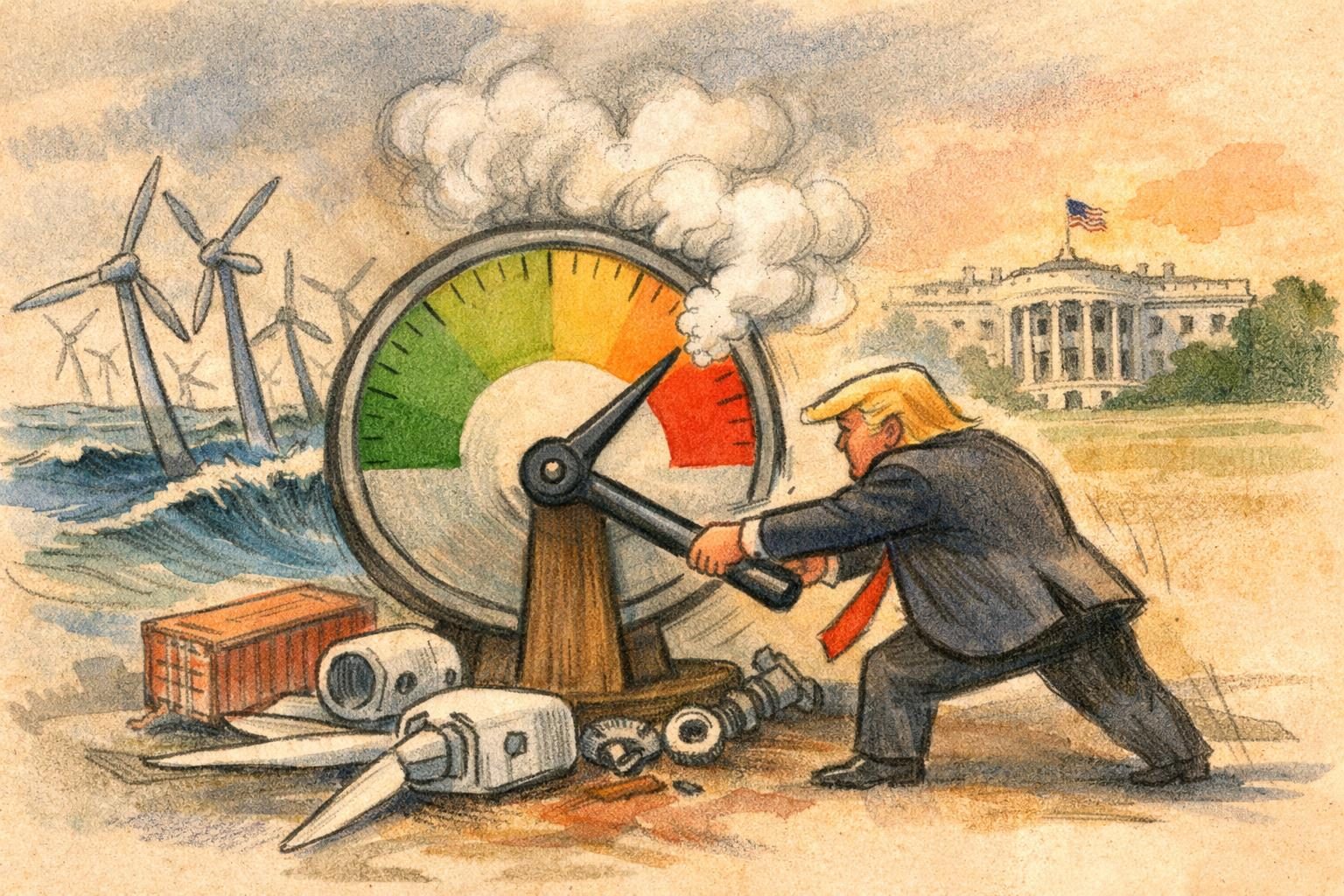
The White House’s Oct. 22 order on wind turbine imports is less a finished trade action than the opening move in a new federal pressure campaign. In the order, President Donald Trump directed Commerce Secretary Howard Lutnick and U.S. Trade Representative Jamieson Greer to begin negotiations over imports of wind turbines and their parts, then return with findings and recommendations within 180 days. The directive does not impose an immediate tariff or other new duty by itself, which is an important distinction even if the political signal is unmistakable. It creates a formal process aimed at a specific set of energy-related imports and leaves open the possibility of later restrictions. That makes the order a concrete policy event, not just a rhetorical warning, and it also shows how the administration is using trade authorities to shape markets before any final enforcement step has been taken.
The wording of the order matters because it frames wind turbine imports as a matter for trade scrutiny rather than simply as a commercial or industrial issue. By instructing Commerce and the U.S. Trade Representative to negotiate first, the administration is giving itself a runway to build a case for possible future action, whether that eventually means tariffs, quotas, or some other remedy. Reuters reported that the order does not itself levy new tariffs, but that it clearly keeps tariff action on the table. That leaves energy developers, equipment suppliers, and manufacturers in a familiar state of uncertainty: they do not yet face a new duty, but they now have to plan around the possibility that one could arrive after the 180-day review window closes. In practice, that kind of uncertainty can ripple through procurement decisions, financing assumptions, and supply contracts long before any policy is fully implemented.
The broader significance is that the administration is again leaning on trade tools to influence the energy sector, and doing so through a national-security style justification that has become a recurring feature of Trump-era trade policy. Supporters are likely to view the order as an attempt to strengthen domestic manufacturing and reduce dependence on imported components in a strategically important industry. Critics, by contrast, are likely to see yet another example of policy volatility that can raise costs for projects already operating on thin margins. Wind energy is especially sensitive to supply-chain disruptions because turbines are large, capital-intensive systems with long lead times and complex sourcing arrangements. Even a process that stops short of immediate tariffs can affect prices, delay purchasing decisions, and make it harder for developers to lock in stable project economics. For consumers, the downstream concern is straightforward: if costs rise anywhere in the chain, they can eventually show up in power prices, project timelines, or both.
This is also why the order should be read as more than an isolated sector action. It illustrates how Trump’s trade team is still willing to use executive authority to put pressure on imports even when the White House stops short of an instant tariff announcement. The administration is not just signaling concern about turbine components; it is creating an official channel for reviewing them and preserving the option to escalate later. That approach can be politically useful because it allows the White House to claim it is taking action on domestic industry without immediately triggering the full economic and diplomatic consequences of a tariff. But it also means the policy remains incomplete and contingent, with the eventual outcome depending on the results of negotiations and the administration’s judgment at the end of the review period. For now, the most concrete fact is the launch of a federal process with a defined deadline, a named set of import targets, and the explicit possibility of stronger trade measures to come.
Comments
Read the discussion freely. Posting and voting require a verified member account. Every comment and reply is screened by AI before publication. Clear spam and abuse are blocked; only strongly cleared comments publish automatically, while uncertain drafts wait for moderator review. Civil factual disagreement alone is not grounds for rejection.
Log in to comment or join free to take part.
No comments yet. Be the first reasonably on-topic person here.