
Veterans seek injunction to stop Trump arch before Nov. 5 work start
Permanent article number: 102526021 Find another article by number
Original article being examined
Published by: Associated Press
Claim examined: The plaintiffs asked a federal judge to block the administration from starting construction on the proposed arch while the lawsuit proceeds.
Original reporting and source documents
Open the reporting and original documents used for this article. These include evidence sources; not every link is necessarily the original claim being examined.
Evidence and accountability
Accountable person, organization or policy: Trump administration and National Park Service arch project
Documented issue under review: The administration is pushing a major federally situated construction project before litigation is resolved, prompting an emergency effort to halt work.
This report has an independent editorial fact-audit recorded in the archive. Check the linked source documents below for the underlying evidence; where a case remains pending, allegations are not findings.
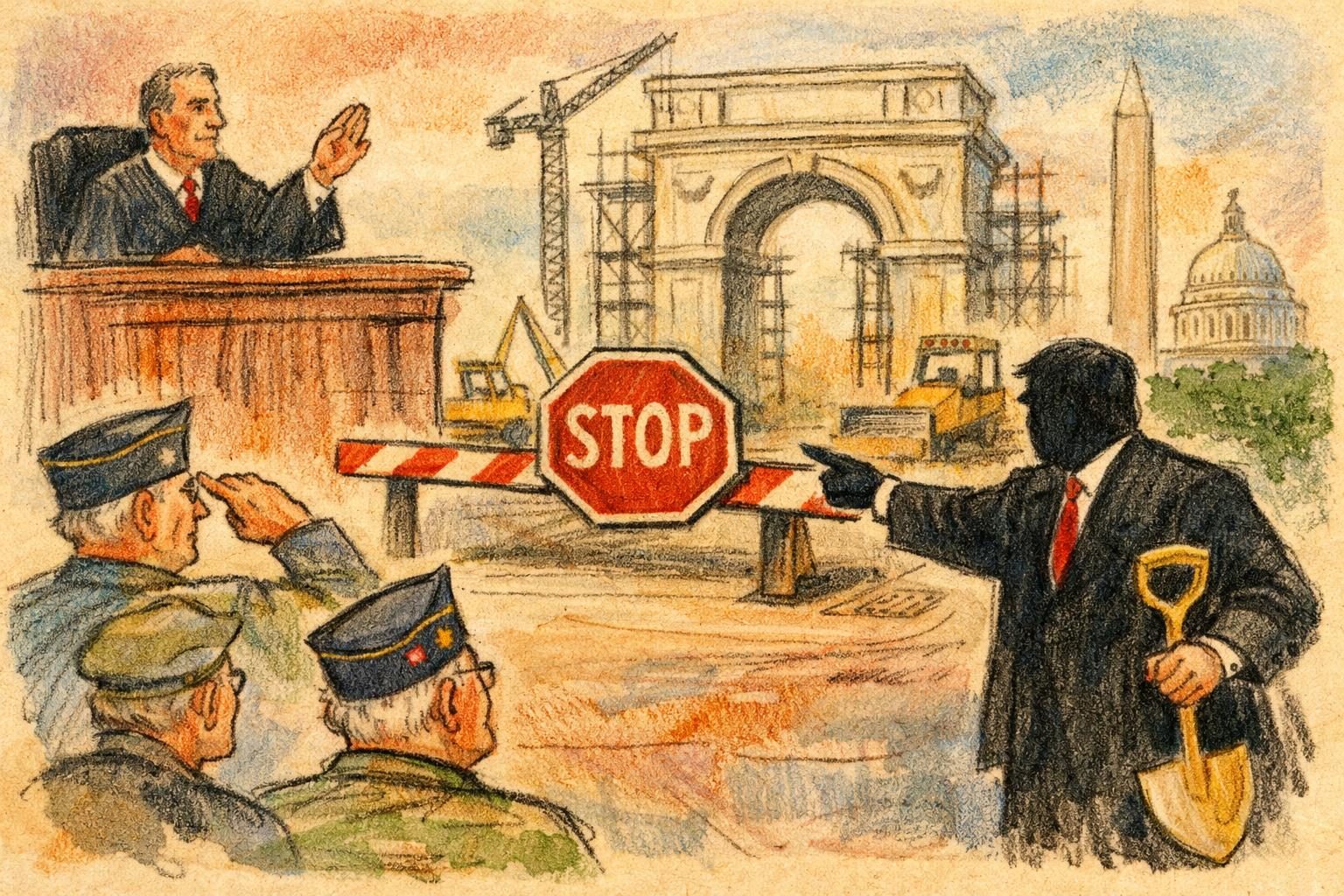
Three veterans and a retired architectural historian have moved to put the brakes on President Donald Trump’s proposed triumphal arch in Washington, asking a federal judge for emergency relief before any construction can begin. Their request came after the National Park Service indicated that work on the project could start on Nov. 5 if the last related approvals are in place. That makes the latest filing less a fresh attack on the arch’s symbolism than a bid to prevent the administration from converting a contested concept into a physical project while the courts are still weighing the dispute. The plaintiffs are seeking an injunction that would bar the government from taking any further step toward construction during the litigation. In practical terms, they want the status quo preserved before any excavation, site preparation or other visible move can begin. The timing matters because the case has already been pending for months, but the start date now appears close enough to create immediate pressure on both sides.
The challenge is rooted in the broader fight over how the arch was approved and who has the legal authority to advance it. The plaintiffs argue that the project should not be allowed to proceed until the court resolves questions about process and federal power, rather than allowing the administration to move ahead first and litigate later. That distinction is important because emergency relief asks the judge not to decide the full merits right away, but to freeze the project while the underlying claims are sorted out. The filing suggests the opponents believe the government’s timeline has become too compressed to allow meaningful judicial review if construction starts as planned. Once ground is broken, the plaintiffs contend, the case would shift from an abstract legal controversy to a partly irreversible development fight over land, planning, and public resources. Even without a ruling on whether the arch itself is lawful or appropriate, the request reflects a new and more urgent phase of the case. It is no longer only about whether the idea can survive scrutiny; it is about whether the administration can be stopped before the project becomes harder to unwind.
The proposed monument has drawn attention because of its size, its symbolism, and the political stakes attached to it. The project has been described as a triumphal arch and is associated with Trump’s effort to leave a lasting mark in Washington. Supporters have presented it as a significant civic addition, while critics have viewed it as an assertion of power that raises procedural and constitutional questions. The plaintiffs in this case are not asking the court to pass on the arch’s aesthetics, but their challenge nonetheless places the design in the middle of a legal battle over federal decision-making. The National Park Service notice is what turned that long-running disagreement into an immediate deadline. If the notice stands and no court intervenes, the administration could proceed once the necessary approvals clear. If the judge grants the requested injunction, the project could be delayed for an uncertain period, and possibly long enough to alter its political momentum. The emergency request therefore carries outsized significance even though it does not resolve the larger legal dispute.
The filing also underscores how quickly the project is moving compared with the pace of litigation. Courts often take time to sort through claims involving federal land use, agency action, and the legality of major public works, but the plaintiffs are arguing that time is now the central problem. They want the judge to act before the Nov. 5 start date so that the government cannot create facts on the ground while the case is still pending. That urgency is part of what makes the development newsworthy: the dispute has shifted from an abstract confrontation over an idea to a race between construction and judicial review. The case remains unresolved, and no court has yet issued a final ruling on the arch’s legality or on the administration’s authority to carry it out. Still, the emergency motion shows that opponents are willing to use every available procedural tool to stop the project from advancing even one step further. Whether the court agrees will determine not just the tempo of the litigation, but whether the arch remains a plan on paper or becomes an active construction site in Washington.
Comments
Read the discussion freely. Posting and voting require a verified member account. Every comment and reply is screened by AI before publication. Clear spam and abuse are blocked; only strongly cleared comments publish automatically, while uncertain drafts wait for moderator review. Civil factual disagreement alone is not grounds for rejection.
Log in to comment or join free to take part.
No comments yet. Be the first reasonably on-topic person here.