
DOJ adds new election-crimes charges in New York as voter-fraud sweep expands
Permanent article number: 102526007 Find another article by number
Original article being examined
Published by: U.S. Department of Justice, Eastern District of New York
Three Defendants Charged with Offenses for Voting as Non-Citizens — Read the exact original
Claim examined: Three defendants were presented in federal court on charges related to illegal voting; one was charged with false claim of citizenship and voting by an alien.
Original reporting and source documents
Open the reporting and original documents used for this article. These include evidence sources; not every link is necessarily the original claim being examined.
Evidence and accountability
Accountable person, organization or policy: Trump Justice Department
Documented issue under review: Escalating election-enforcement campaign built around allegations that remain unproven at the charging stage.
This report has an independent editorial fact-audit recorded in the archive. Check the linked source documents below for the underlying evidence; where a case remains pending, allegations are not findings.
Questions sent by Radical Reading Room
These requests have a recorded outbound message ID and send time. A request for comment does not establish that its recipient read the message.
U.S. Department of Justice Office of Public Affairs — Media inquiries
Question: What specific evidence did federal prosecutors in the Eastern District of New York present to support the charges against Eoin Cranney for making a false claim of citizenship and voting by an alien?
Contacted: October 25, 2026 at 10:30 AM (server time).
Status: Response pending; no substantive response recorded.
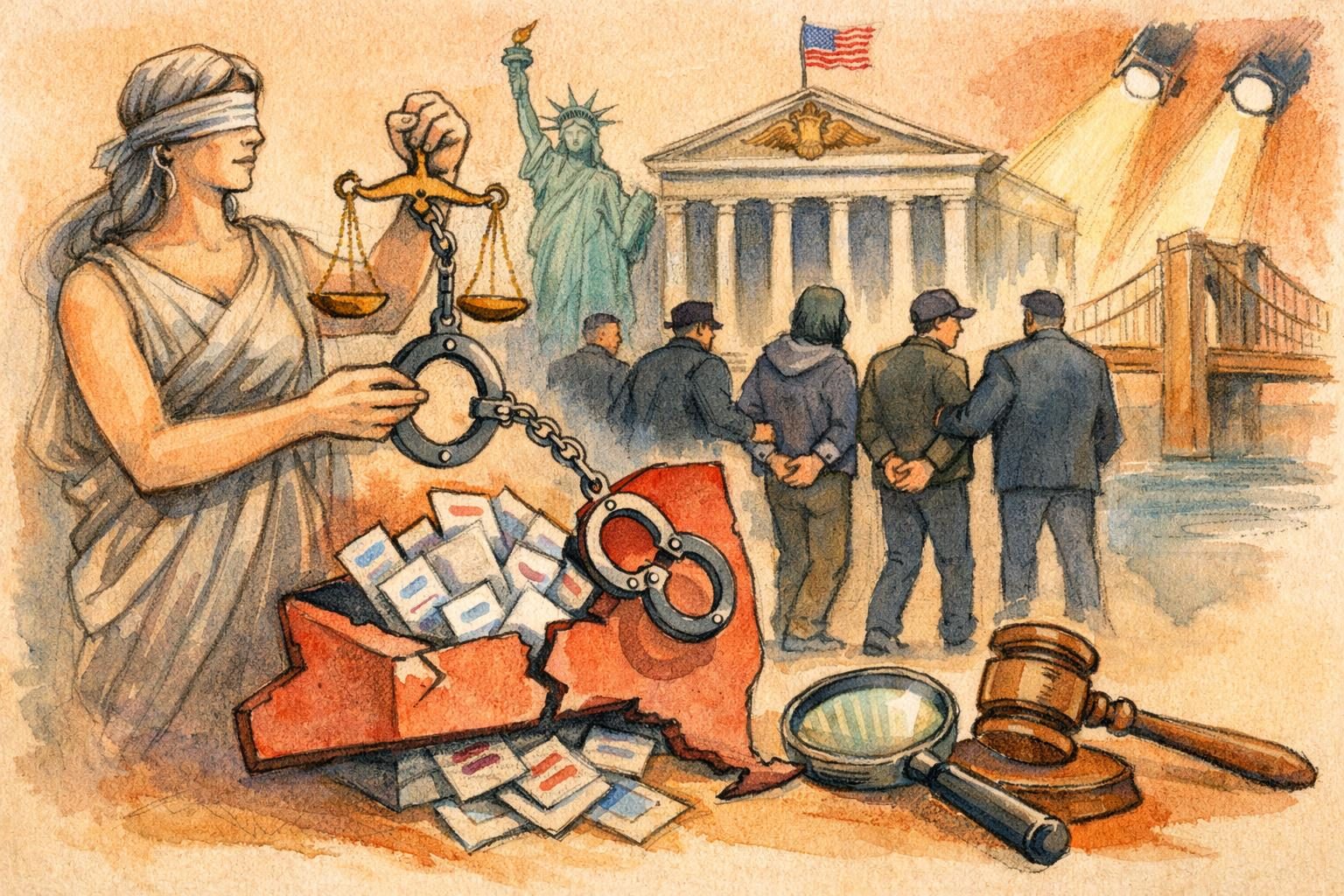
Federal prosecutors in the Eastern District of New York said on October 23 that three defendants had been presented in federal court on charges tied to illegal voting in federal elections, adding a new New York case to a broader late-October federal push on election-related offenses. One of the defendants, Eoin Cranney, was charged by indictment with making a false claim of citizenship in order to vote and with voting by an alien. The allegations are serious, but they remain allegations, not findings of guilt, and all of the defendants are presumed innocent unless and until proven otherwise in court. Even so, the filing is a concrete enforcement action with immediate legal and political significance. It marks another step in a visible federal effort to turn election-integrity messaging into active criminal cases. In practical terms, it shows that the Justice Department’s election-crimes posture is not confined to a single jurisdiction or a single defendant, but is being pushed through multiple districts.
The New York announcement matters partly because of what it suggests about the department’s current enforcement rhythm. Rather than treating election fraud as a one-off talking point, federal officials have been using indictments, informations, and public announcements to underscore a larger claim that unlawful voting conduct is being pursued aggressively. That approach gives the administration a way to pair rhetoric with visible courtroom activity, especially at a time when voting rules, voter eligibility, and election security remain highly charged political issues. The Eastern District filing fits that pattern by putting names, charges, and a date on the public record. It also makes clear that prosecutors are not simply warning about election crimes in the abstract. They are filing cases, presenting defendants, and publicizing those actions in a way that is meant to signal seriousness. For supporters of a tougher line on election enforcement, the message is that prosecutors are moving beyond statements and into real cases. For critics, the concern is that the government may be amplifying unproven allegations in a politically sensitive area where the consequences extend beyond the courtroom.
The timing is important as well. The cases were announced in the run-up to the midterms, when election administration and ballot access are once again likely to become focal points in national politics. That gives the filing a significance beyond the immediate facts of the indictment itself. Federal election-crimes cases can have a ripple effect even before any verdict is reached because they shape public debate, drive media coverage, and influence how voters and officials think about the integrity of the system. At the same time, readers should be careful not to overread what the filing proves. A charge is not evidence of a completed scheme, and it does not establish a broader pattern of misconduct by any group of voters. The strongest factual claim available at this stage is narrower: prosecutors in New York say they have enough to present these charges in federal court. That alone is newsworthy because it reflects a shift from general warnings about election crime to specific criminal allegations in a major district.
The New York case also sits alongside a wider Justice Department announcement involving election-crimes enforcement, including a separate public statement about charges involving 16 individuals. Taken together, the filings indicate a multi-district pattern rather than an isolated local action. That is why the development has drawn attention beyond the particulars of any one defendant. It suggests that federal prosecutors are building a visible campaign around alleged election offenses, with the Eastern District of New York now part of that rollout. The exact outcome of the cases remains unknown, and it would be premature to treat the charges as proof of a larger crisis. But in political terms, the significance is already clear: the administration is using the criminal-justice system to reinforce its voter-fraud narrative while the campaign season intensifies. Whether the cases ultimately lead to convictions or are narrowed, dismissed, or resolved in some other way, the filing itself is a real and consequential event. It shows how election enforcement is being used not only as a legal tool but also as a public signal, one that is likely to keep reverberating well beyond New York.
Comments
Read the discussion freely. Posting and voting require a verified member account. Every comment and reply is screened by AI before publication. Clear spam and abuse are blocked; only strongly cleared comments publish automatically, while uncertain drafts wait for moderator review. Civil factual disagreement alone is not grounds for rejection.
Log in to comment or join free to take part.
No comments yet. Be the first reasonably on-topic person here.