
DOJ files new Nevada illegal-voting case as election-security push widens
Permanent article number: 102526012 Find another article by number
Original article being examined
Published by: U.S. Department of Justice, U.S. Attorney's Office for the District of Nevada
Alien Charged for Illegal Voting — Read the exact original
Claim examined: DOJ filed a new federal illegal-voting case in Nevada alleging a noncitizen voted in a federal election.
Original reporting and source documents
Open the reporting and original documents used for this article. These include evidence sources; not every link is necessarily the original claim being examined.
Evidence and accountability
Accountable person, organization or policy: Trump Justice Department
Documented issue under review: The department is escalating election-fraud enforcement through new cases and public messaging, which may bolster fraud narratives even as individual allegations remain unproven.
This report has an independent editorial fact-audit recorded in the archive. Check the linked source documents below for the underlying evidence; where a case remains pending, allegations are not findings.
Questions sent by Radical Reading Room
These requests have a recorded outbound message ID and send time. A request for comment does not establish that its recipient read the message.
U.S. Department of Justice — Public professional press contact
Question: How many total illegal voting cases related to noncitizens has the DOJ filed nationwide since the start of the 2024 election cycle?
Contacted: October 25, 2026 at 3:54 PM (server time).
Status: Response pending; no substantive response recorded.
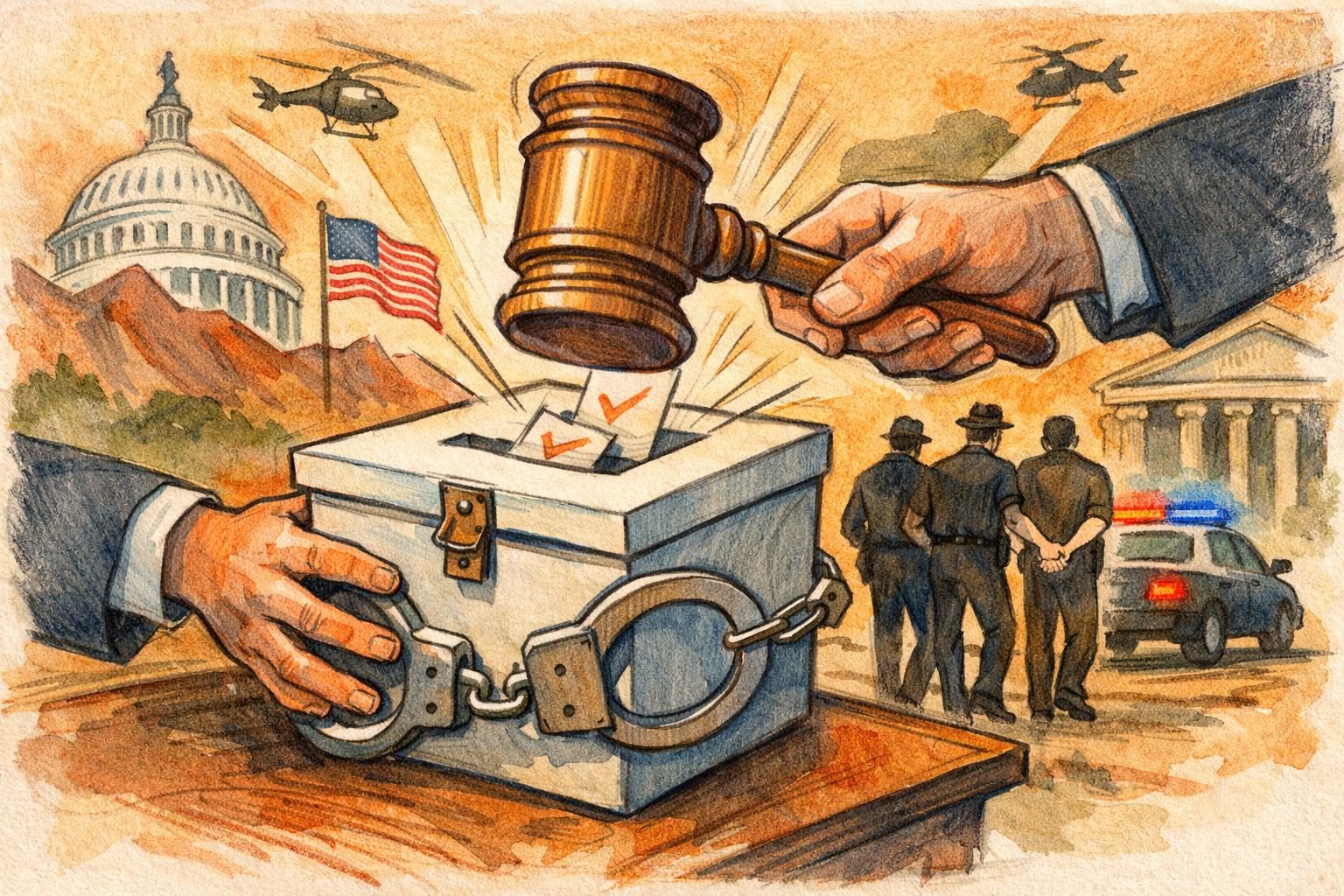
The Justice Department’s latest Nevada filing adds a concrete legal step to an election-enforcement campaign that the Trump administration has been widening for weeks. On Oct. 23, federal prosecutors in Nevada announced that a defendant had been charged with illegal voting in a federal election. According to the department, the criminal information alleges that a noncitizen voted in the 2024 election, making the case one of the administration’s newest public examples of what it says is a broader effort to police election eligibility rules. The filing is not a finding of guilt, and the defendant is presumed innocent unless and until the charge is proved in court. Even so, the case is significant because it moves the administration’s election-security message from political rhetoric into an enforceable legal action that can be checked in public records.
That distinction matters because the administration has been trying to show that its concerns about election integrity are not just talk. The Nevada case is part of a pattern in which the Justice Department has been highlighting voting-related investigations and charges as evidence that it is taking a tougher line on election enforcement. Rather than presenting the matter as an isolated incident, the department has framed it as one example of a larger federal posture toward election violations. That approach gives the filing outsized political weight, especially for voters who are already sensitive to claims about ballot access, voter eligibility, and election integrity. It also gives the department a ready-made talking point: that it is not merely warning about fraud, but actively bringing cases it says are grounded in law and evidence.
The same week, that broader message was reinforced by other Justice Department activity in multiple states. DOJ offices elsewhere announced election-integrity plans or designated public points of contact for complaints, signaling a coordinated federal effort heading into the 2026 midterms. Those announcements do not prove a specific pattern of fraud, but they do show that the administration is building a visible enforcement architecture around voting rules and election complaints. Taken together, the Nevada charge and the parallel state-level outreach suggest a deliberate strategy to make election enforcement more prominent in public view. Supporters are likely to argue that this is exactly what federal law enforcement should do: investigate violations, bring charges where warranted, and reassure the public that citizenship and eligibility rules are being taken seriously. Critics are likely to see something different, namely an attempt to elevate a small number of cases into a much larger political narrative about election legitimacy.
That tension is what makes the Nevada filing politically meaningful even before any court outcome. On one hand, the Justice Department is entitled to investigate alleged violations and pursue them through the criminal process when it believes the facts support a charge. On the other hand, the public impact of those steps can be broader than the legal case itself, especially when the administration uses them to reinforce a wider message about fraud, border enforcement, or the integrity of the electoral system. The case therefore functions in two ways at once: as a routine criminal filing and as part of a communications campaign aimed at shaping how voters think about elections ahead of a major federal cycle. The department’s public emphasis on these matters can make election enforcement appear more aggressive and more coordinated than in a typical year, regardless of how many cases ultimately result in convictions or are dismissed.
The source material also places the Nevada matter alongside another Justice Department announcement involving election crimes in California, underscoring that the administration’s enforcement push is not confined to one state. In the California case, DOJ said it had charged 28 foreign nationals with election-related crimes, another example of the department’s willingness to publicize voting-enforcement actions prominently. Together with the Nevada filing, that announcement signals a broader institutional posture: the department is using criminal charges, public statements, and state-by-state contact points to make election integrity a visible federal priority. That does not mean the administration’s concerns are baseless, and it does not mean every allegation is politically motivated. But it does mean the White House and the Justice Department are trying to shape the public conversation about elections through a steady stream of enforcement actions that blur the line between criminal law and political messaging. For now, the Nevada defendant’s case remains an allegation only, but the administration’s decision to publicize it so forcefully makes the filing newsworthy well beyond the narrow facts of the charge.
Comments
Read the discussion freely. Posting and voting require a verified member account. Every comment and reply is screened by AI before publication. Clear spam and abuse are blocked; only strongly cleared comments publish automatically, while uncertain drafts wait for moderator review. Civil factual disagreement alone is not grounds for rejection.
Log in to comment or join free to take part.
No comments yet. Be the first reasonably on-topic person here.