
Trump exempts some Canadian imports after tariff backlash
Permanent article number: 102326012 Find another article by number
Original reporting and source documents
Open the reporting and original documents used for this article. These include evidence sources; not every link is necessarily the original claim being examined.
Evidence and accountability
Accountable person, organization or policy: President Donald Trump
Documented issue under review: After imposing steep Canadian tariffs that drew complaints about higher costs, Trump granted partial exemptions for some imports, undercutting his own cost-control claims.
This report has an independent editorial fact-audit recorded in the archive. Check the linked source documents below for the underlying evidence; where a case remains pending, allegations are not findings.
Questions sent by Radical Reading Room
These requests have a recorded outbound message ID and send time. A request for comment does not establish that its recipient read the message.
The United States Trade Representative (USTR) — Public professional press contact
Question: Which specific Canadian imports are exempted from the 50% tariffs?
Contacted: October 25, 2026 at 10:14 AM (server time).
Status: Response pending; no substantive response recorded.
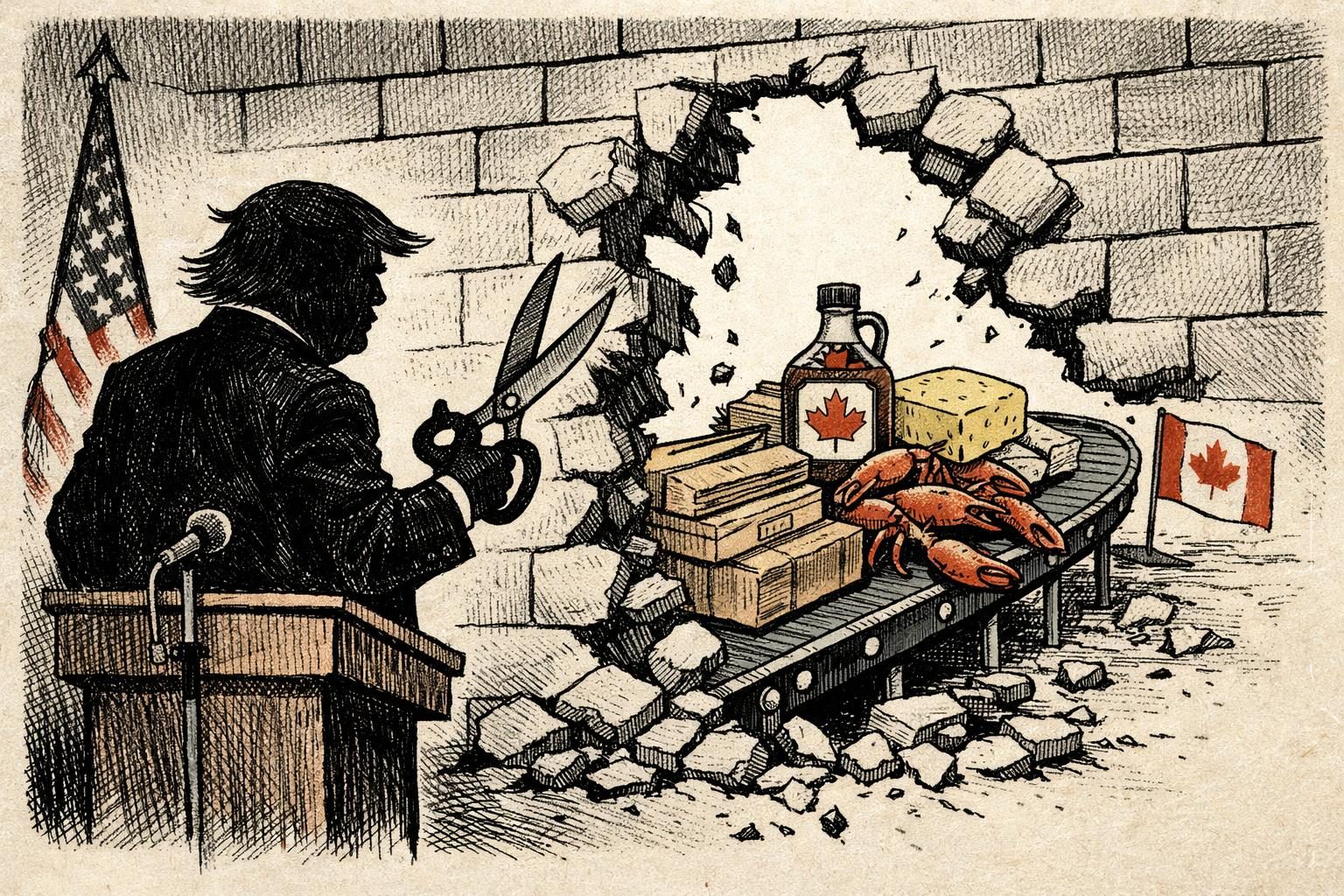
President Donald Trump on Friday carved out exemptions for some Canadian imports from the 50% tariffs he imposed earlier this year, a notable retreat after months of criticism that his trade policy was driving up costs for families and businesses, especially in places such as Maine. The change covers some products that are widely used in commerce, including plywood sheets, packing crates and certain kinds of machinery, according to AP. It comes after repeated complaints from Republican Sen. Susan Collins, who said she had been pressing administration officials about “the toll tariffs are taking on Maine families, businesses, farmers, and growers.” The White House framed the move as an effort to reduce “the burden to U.S. commerce while better serving the public interest,” language that suggests the administration sees the adjustment as an act of calibration rather than a reversal. Even so, the decision is a clear acknowledgment that the tariff regime has produced political and economic pressure the president can no longer ignore.
The timing gives the announcement added weight. Trump has made tariffs one of the signature tools of his economic and political agenda, repeatedly arguing that they will protect American industry and do not meaningfully burden U.S. consumers. But AP’s reporting underscores a basic reality that has long complicated that claim: importers in the United States pay the tariffs, and those costs are often shifted along to customers, contractors or end buyers. That means the pain does not stop at the border, even if the policy is aimed at foreign exporters. In practical terms, the burden can show up in everything from construction materials to farm equipment and packaging supplies, which helps explain why the complaints from Maine resonated so quickly. The carveout therefore reads less like a technical tweak than a response to visible political fallout from a policy Trump himself put in place. It also reinforces the idea that tariff decisions can have domestic consequences well before they produce any of the broader leverage the administration says it wants.
Collins’s involvement is especially telling because it highlights the pressure point inside Trump’s own political coalition. A Republican senator from a state that depends heavily on trade-sensitive industries, Collins has argued that the tariffs were imposing costs on businesses, farmers and growers that could not simply be absorbed without consequence. Her intervention shows how the issue moved from abstract trade theory to a concrete complaint about household and commercial budgets. That matters in a state like Maine, where small businesses and rural producers can feel cost increases quickly and where changes in pricing are often visible to voters. The White House’s decision to exempt at least some Canadian imports suggests that those complaints reached the level of action, even if the administration did not present the move as a major policy concession. It also raises a familiar political question: when tariffs create enough pain to require exceptions, how broad is the benefit of the policy in the first place?
There is, however, a strong counterargument available to the administration, and it should not be overstated to ignore it. Trump did not end the tariffs, and the exemption appears targeted rather than sweeping, which allows the White House to say it is refining the policy instead of abandoning it. That distinction matters because the administration can still argue it is protecting the public interest while relieving a narrow set of burdens on U.S. commerce. The change is set to take effect Oct. 30, and AP placed it against a broader backdrop of public frustration over the cost of living, including an AP-NORC poll showing 65% of respondents blaming Trump’s policies for persistently high prices. Taken together, the exemption and the political context suggest a White House trying to hold onto the symbolism of toughness while acknowledging the practical limits of the tariff strategy. For now, the move narrows the policy rather than overturning it, but it also offers a clear sign that the administration is responding to the costs it previously insisted would not matter."}]}
Comments
Read the discussion freely. Posting and voting require a verified member account. Every comment and reply is screened by AI before publication. Clear spam and abuse are blocked; only strongly cleared comments publish automatically, while uncertain drafts wait for moderator review. Civil factual disagreement alone is not grounds for rejection.
Log in to comment or join free to take part.
No comments yet. Be the first reasonably on-topic person here.