
Trump’s Alaska election lawsuit is a new escalation, not just rhetoric, in the fight over ballot confusion
Permanent article number: 102526010 Find another article by number
Original article being examined
Published by: Associated Press
Original reporting and source documents
Open the reporting and original documents used for this article. These include evidence sources; not every link is necessarily the original claim being examined.
Evidence and accountability
Accountable person, organization or policy: Trump administration and Justice Department
Documented issue under review: A formal federal lawsuit seeks to block Alaska certification if the Republican Senate candidate loses, turning partisan election claims into an official intervention in the state process.
This report has an independent editorial fact-audit recorded in the archive. Check the linked source documents below for the underlying evidence; where a case remains pending, allegations are not findings.
Corrections and clarifications
October 25, 2026: October 25, 2026: Corrected the Alaska lawsuit filing date from October 23 to October 22, 2026, and clarified that the proposed certification restriction concerns incumbent Republican Dan S. Sullivan. Trump publicly acknowledged directing the filing on October 23. Replaced a generic Reuters news-index link with a directly relevant, independently published Guardian report. The lawsuit remains pending, not a court finding of voter confusion. Original URL retained.
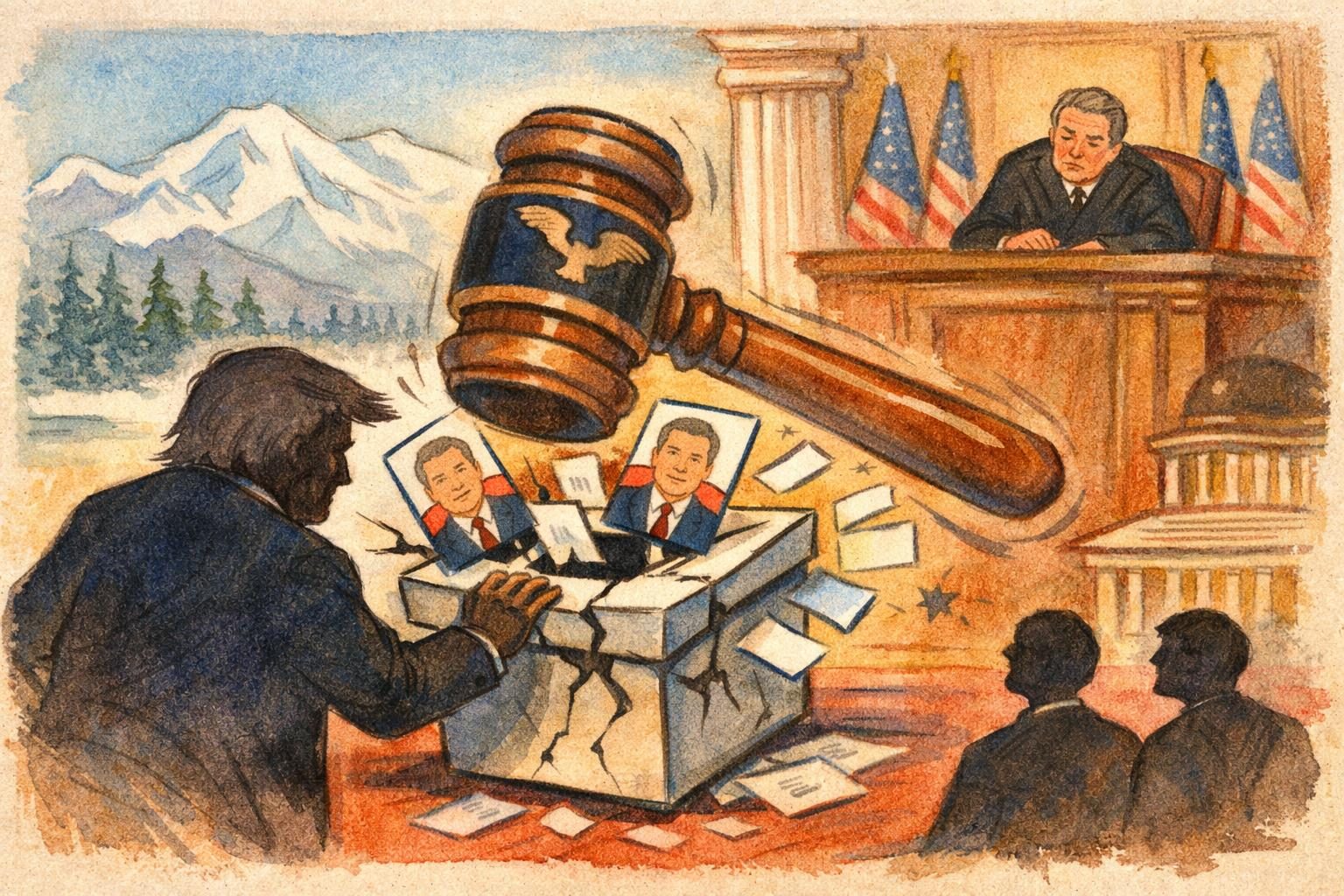
The Trump administration moved beyond rhetoric into formal litigation over Alaska’s U.S. Senate race when the Justice Department filed a lawsuit on October 22, 2026, seeking to block certification if Republican incumbent Dan S. Sullivan loses. The case centers on a Republican argument that ballots could be confused by the presence of two candidates with the same name, Dan Sullivan, in a contest that could matter for Senate control. Trump said he personally directed the Justice Department to bring the suit, making the filing not just a legal maneuver but a public assertion of presidential will over an election process still unfolding. AP reported the development as the administration’s first step to block the results of a midterm election, which underscores how unusual the move is even before any court rules on the merits. At this stage, the lawsuit does not establish wrongdoing by either candidate, but it does establish something more consequential than a campaign complaint: the federal government is trying to shape how a state certifies an election outcome before the outcome is final.
That distinction matters because certification is the point at which vote totals become an official result. In ordinary post-election disputes, candidates, campaigns, or outside groups may challenge ballots, request recounts, or contest procedures after the count is complete. What makes this case notable is that the challenge is aimed at the certification process itself, and it arrives before the election has been fully resolved. That is why the filing reads as a procedural escalation rather than a mere talking point about voter confusion. The underlying claim—that a pair of similarly named candidates could mislead voters—may ultimately be tested in court, and it may or may not hold up under scrutiny. But the immediate significance lies in the federal government’s decision to intervene in a state election dispute at a stage when courts usually expect the democratic process to run its course. The suit places the Justice Department inside a partisan fight over ballot clarity and asks judges to decide whether that fight is enough to justify delaying or blocking certification.
The political context gives the case even more weight. According to AP, the dispute is tied to a Senate seat whose outcome could affect control of the chamber, which helps explain why it has drawn attention far beyond Alaska. Trump’s direction to the Justice Department makes this less like a routine legal challenge and more like an explicit use of federal power to protect a preferred political outcome. That does not prove the administration is acting unlawfully, and it does not prove that voters were actually confused. It does, however, show the White House embracing a strategy that treats an unresolved state election as a target for federal intervention. Reuters also flagged the broader stakes of the moment as part of the national political fight over election administration, reinforcing that this is not just a local ballot issue but a test of how far federal authority can be pushed into state election machinery. For critics, that raises obvious concerns about precedent: if a president can direct his Justice Department to try to stop certification in one race, what limits would apply in another?
For now, the most responsible reading is to separate the factual question from the institutional one. The factual question is whether two Dan Sullivans on the ballot created genuine confusion substantial enough to affect voters or the count. The institutional question is whether the federal government should be in court trying to block certification before the election result is final, especially in a race where the stakes are partisan and the party in power has an obvious interest in the outcome. The AP report makes clear that the litigation is real and that Trump has openly claimed ownership of it, which makes the action more than a background legal skirmish. Even without a final judgment, the filing marks a significant escalation in the way election disputes are being prosecuted at the federal level. It is one thing to complain about ballot confusion during a campaign; it is another to use the Justice Department to try to shape the official endpoint of a state election before voters’ choices are fully translated into law. That is why this case matters now, regardless of how the court ultimately responds.
Comments
Read the discussion freely. Posting and voting require a verified member account. Every comment and reply is screened by AI before publication. Clear spam and abuse are blocked; only strongly cleared comments publish automatically, while uncertain drafts wait for moderator review. Civil factual disagreement alone is not grounds for rejection.
Log in to comment or join free to take part.
No comments yet. Be the first reasonably on-topic person here.