
White House credits Melania Trump with brokering a localized Ukraine ceasefire
Permanent article number: 102526018 Find another article by number
Original reporting and source documents
Open the reporting and original documents used for this article. These include evidence sources; not every link is necessarily the original claim being examined.
Evidence and accountability
This report has an independent editorial fact-audit recorded in the archive. Check the linked source documents below for the underlying evidence; where a case remains pending, allegations are not findings.
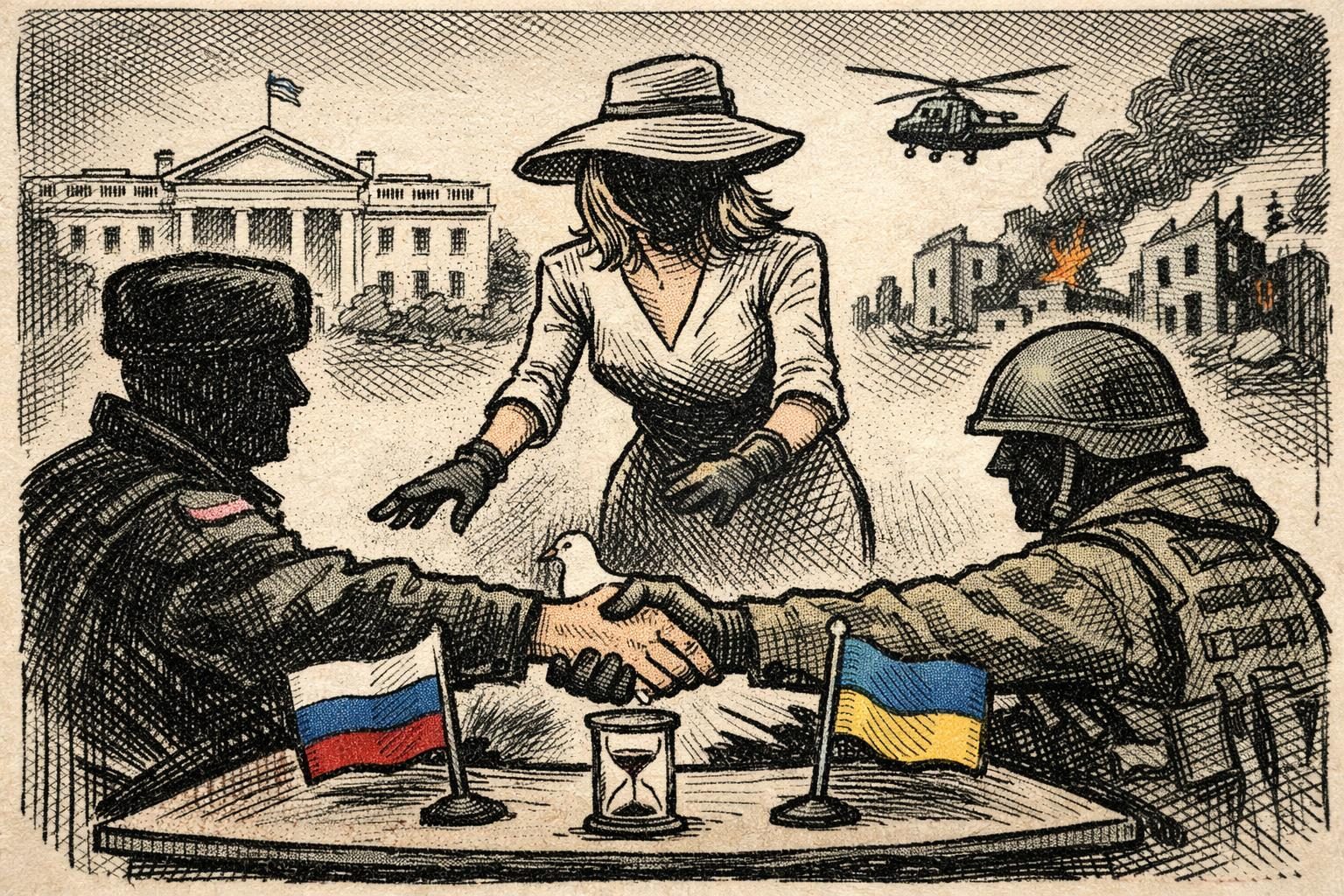
On Oct. 23, the White House said Melania Trump helped secure a limited ceasefire in Oleshky, a Russian-occupied town in southern Ukraine, in what amounts to an unusual and closely watched diplomatic episode. According to the accounts circulated by the administration and reported by multiple outlets, the arrangement was narrow in scope and tied to a specific humanitarian purpose: allowing aid to move in and civilians to be evacuated. Oleshky sits in an area where fighting and occupation have made ordinary relief efforts difficult, so even a temporary pause can have immediate consequences for people on the ground. The reported deal does not amount to a broader peace settlement, nor does it resolve the wider war, but it is notable because it places the first lady in a direct mediating role in an active conflict. That alone makes the story stand out from routine White House messaging, since it blends humanitarian diplomacy, political symbolism, and the administration’s preferred style of highly personalized decision-making.
The basic outline of the ceasefire appears to have been confirmed in broad terms by Russian and Ukrainian officials, though the exact mechanics remained unclear as of the reports. That uncertainty matters, because a localized pause in fighting can be described in several different ways depending on who is talking and what exactly has been agreed to on the ground. The reports suggested that the arrangement was limited rather than comprehensive, with the immediate goal of moving supplies and helping civilians leave the area safely. Even so, the practical stakes are real: in a war zone, a short-lived pause can mean access to medicine, food, water, and evacuation routes that would otherwise be impossible. The White House’s decision to describe Melania Trump as having brokered the ceasefire gives the episode a distinctly personal imprint, but the available accounts do not fully spell out what role she played, what channels were used, or how much of the outcome depended on her involvement versus the broader diplomatic machinery around her. That gap between the headline claim and the public record is part of what makes the story so consequential and so hard to assess cleanly.
From a political and institutional perspective, the episode raises questions less about legality than about process, transparency, and the administration’s approach to foreign policy. There is nothing inherently improper about informal diplomacy, and presidents have long relied on family members, trusted allies, and unofficial envoys in moments of crisis. But this case is unusual because the reported mediation is being attributed to the first lady in an active war setting, with a result that carries immediate humanitarian implications. That creates a blurred line between private influence and public authority, especially when the details are still emerging and the public is relying largely on self-attributed credit and confirmation from the parties involved. A fair reading of the event should avoid overstating what is known, but it should also acknowledge how unusual it is for the White House to present a first lady as a direct facilitator of battlefield-related diplomacy. In practical terms, the reported ceasefire may prove more important for what it does than for how it was negotiated, yet the method still matters because it reflects who is shaping American diplomatic engagement and through what channels. For observers concerned about democratic accountability, the question is not whether the move was unlawful, but whether this personalized style of foreign-policy intervention leaves too much of the process opaque.
The broader significance of the Oleshky arrangement lies in the contrast between a limited humanitarian breakthrough and the continuing uncertainty of the war itself. A temporary ceasefire in one town cannot be mistaken for a shift in the overall trajectory of the conflict, and nothing in the reported agreement suggests that it changes the strategic balance between Russia and Ukraine. Still, the fact that the White House credited Melania Trump with helping to make it happen means the episode has immediate political resonance at home as well as humanitarian impact abroad. It offers the administration a chance to point to a concrete result, while also inviting scrutiny over how such results are being pursued and presented. Because the fact pattern is still developing, any careful account has to preserve that uncertainty and avoid turning a limited report into a sweeping conclusion. What can be said with confidence is that the White House publicly tied the first lady to a localized ceasefire intended to move aid and evacuate civilians, that Russian and Ukrainian officials appear to have acknowledged the basic framework, and that the episode is significant precisely because it is both narrow and real. In that sense, it is not just another messaging exercise or campaign-style flourish; it is a live diplomatic development with tangible implications for civilians caught in a war zone, and it merits close scrutiny for both its humanitarian upside and its highly personalized method of execution.
Comments
Read the discussion freely. Posting and voting require a verified member account. Every comment and reply is screened by AI before publication. Clear spam and abuse are blocked; only strongly cleared comments publish automatically, while uncertain drafts wait for moderator review. Civil factual disagreement alone is not grounds for rejection.
Log in to comment or join free to take part.
No comments yet. Be the first reasonably on-topic person here.