
DOJ orders California counties to sequester and verify ballots tied to suspected noncitizens
Permanent article number: 102526005 Find another article by number
Original article being examined
Published by: Associated Press
DOJ orders some California counties to verify ballots in 48 hours — Read the exact original
Claim examined: County registrars were told to set aside and verify ballots that the Justice Department said may belong to noncitizens.
Original reporting and source documents
Open the reporting and original documents used for this article. These include evidence sources; not every link is necessarily the original claim being examined.
Evidence and accountability
Accountable person, organization or policy: Trump Justice Department
Documented issue under review: Escalated a disputed noncitizen-voting theory into immediate ballot-sequestration demands on California counties.
This report has an independent editorial fact-audit recorded in the archive. Check the linked source documents below for the underlying evidence; where a case remains pending, allegations are not findings.
Corrections and clarifications
October 25, 2026: October 25, 2026: Corrected the date of federal prosecutors letters from October 24 to Friday, October 23, 2026. Added independent San Francisco Chronicle reporting alongside original Associated Press coverage. The underlying earlier lawsuit is distinct. Original permalink retained for continuity.
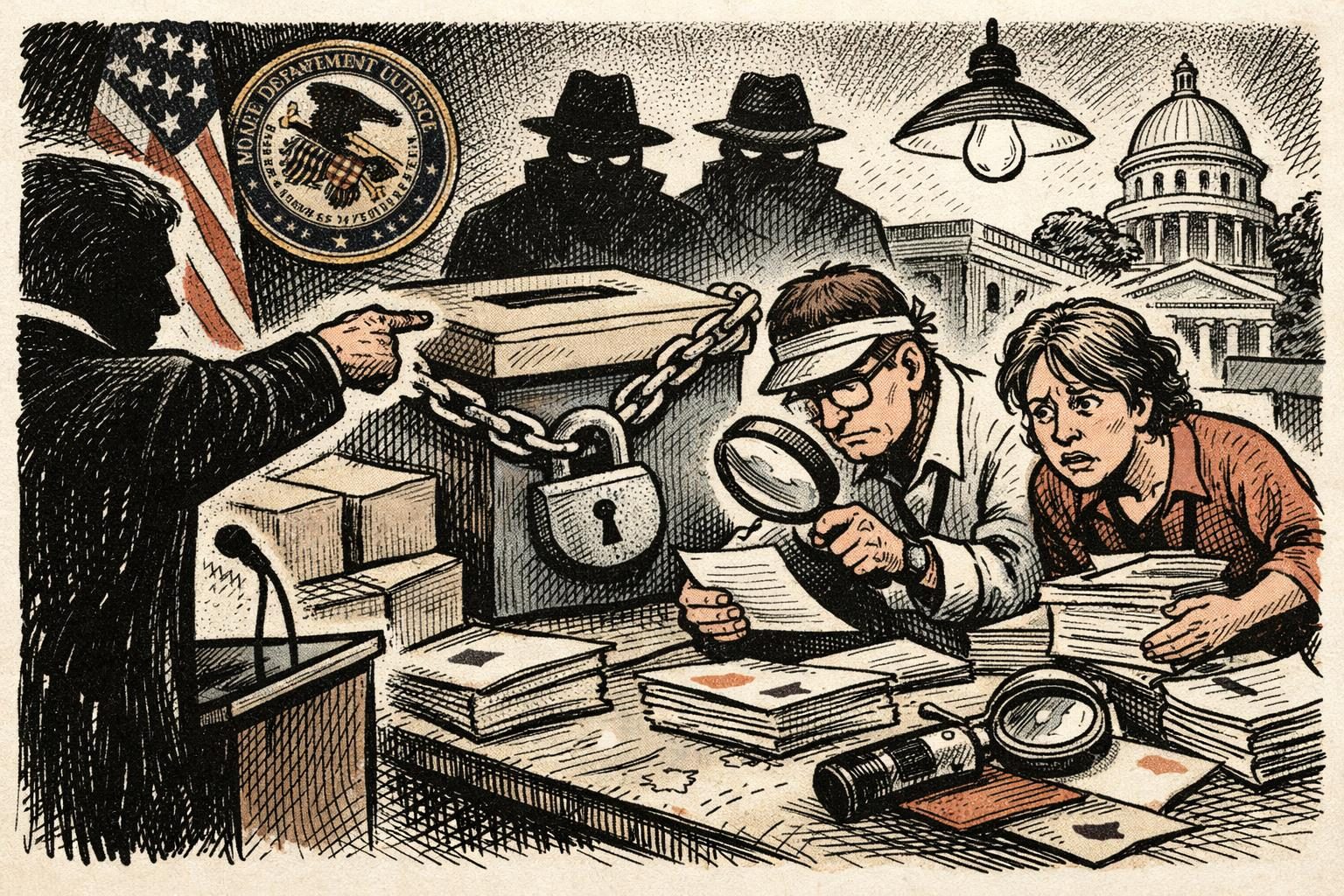
Federal prosecutors have sharply intensified their confrontation with California election officials by ordering counties to set aside and verify ballots that the Justice Department believes may have been cast by noncitizens. The letters, sent on Oct. 23 to county registrars, represent a new phase in a fight that has already moved through the courts and is now reaching directly into election administration during the final stretch before the midterm vote. AP reported that the federal demand follows earlier litigation in which the Justice Department sought to block California from counting roughly 20,000 ballots it said were tied to “likely” noncitizen voters. What changed on Friday was not a court ruling, but the pressure placed on local officials to treat a contested set of ballots as a problem to be managed immediately. In practical terms, that means county offices are being asked to isolate votes, check records, and respond to a federal allegation while the election is still unfolding.
The significance of the move lies less in any settled legal conclusion than in the operational burden it imposes. County registrars are already working under tight deadlines, processing ballots, resolving voter verification issues, and preparing to certify results under state rules. By ordering counties to sequester ballots the department suspects may be problematic, the Justice Department is asking election workers to take precautionary steps before any court has made a final determination about those votes. That distinction is crucial. The demand does not establish that illegal voting occurred, and it does not amount to a judicial finding that the ballots in question are invalid. It is, instead, a federal assertion of suspicion backed by a request for preservation and review. AP’s reporting underscores that alleged noncitizen voting remains rare and difficult to prove, which makes the underlying dispute both politically explosive and evidentiary fragile. The administration is acting as though the ballots may be tainted, while state and local officials must decide how to handle the claim without prematurely treating it as fact.
The broader context is the Trump administration’s continuing election-fraud campaign, which has increasingly relied on public allegations, legal threats, and demands for extraordinary scrutiny of ballots and voters. In California, that pressure has now been translated from litigation into direct administrative action. That shift matters because counties are not just being asked to defend a policy position; they are being told to alter day-to-day election processing in response to a federal allegation. The result is a new layer of uncertainty for local offices that must preserve ballot integrity while also avoiding actions that could undermine confidence in the count or create the appearance that lawful ballots are being singled out. The Justice Department’s move also broadens the political impact of the dispute, since it is arriving at a moment when election administrators are under intense public scrutiny and under little room to absorb extra work. Even if the underlying allegation ultimately proves unfounded or only partially supported, the immediate effect is real: more delay, more review, and more pressure on county election systems already near capacity.
That makes this story less about a resolved case than about how federal power is being used in the election environment. The central unresolved question is whether the government has narrow, reliable evidence that justifies such disruptive demands, or whether it is stretching uncertain claims into an aggressive pressure campaign aimed at local officials. From the reporting available so far, that question remains open. The letters show that the Justice Department wants ballots preserved and verified; they do not show that fraud has been proven, nor do they settle the legal status of the ballots themselves. What is clear is that the administration has chosen to escalate at a sensitive point in the electoral calendar, forcing counties to react before the vote is complete. That is why the development is newsworthy even without a final factual finding: it reveals how election disputes can become operational crises long before courts issue a definitive ruling. For county officials, the immediate task is compliance and documentation; for voters, the larger concern is whether a contested federal intervention will complicate the administration of ballots that are still in the process of being counted.
Comments
Read the discussion freely. Posting and voting require a verified member account. Every comment and reply is screened by AI before publication. Clear spam and abuse are blocked; only strongly cleared comments publish automatically, while uncertain drafts wait for moderator review. Civil factual disagreement alone is not grounds for rejection.
Log in to comment or join free to take part.
No comments yet. Be the first reasonably on-topic person here.