
How North Carolina’s 13th District became a measure of Congress’s shrinking competition
Permanent article number: 102526008 Find another article by number
Original article being examined
Published by: Associated Press
Original reporting and source documents
Open the reporting and original documents used for this article. These include evidence sources; not every link is necessarily the original claim being examined.
Evidence and accountability
This report has an independent editorial fact-audit recorded in the archive. Check the linked source documents below for the underlying evidence; where a case remains pending, allegations are not findings.
Questions sent by Radical Reading Room
These requests have a recorded outbound message ID and send time. A request for comment does not establish that its recipient read the message.
North Carolina General Assembly — Public professional press contact
Question: What specific criteria and data were used by the North Carolina state legislature in redrawing the 13th Congressional District boundaries for the latest map?
Contacted: October 25, 2026 at 1:54 PM (server time).
Status: Response pending; no substantive response recorded.
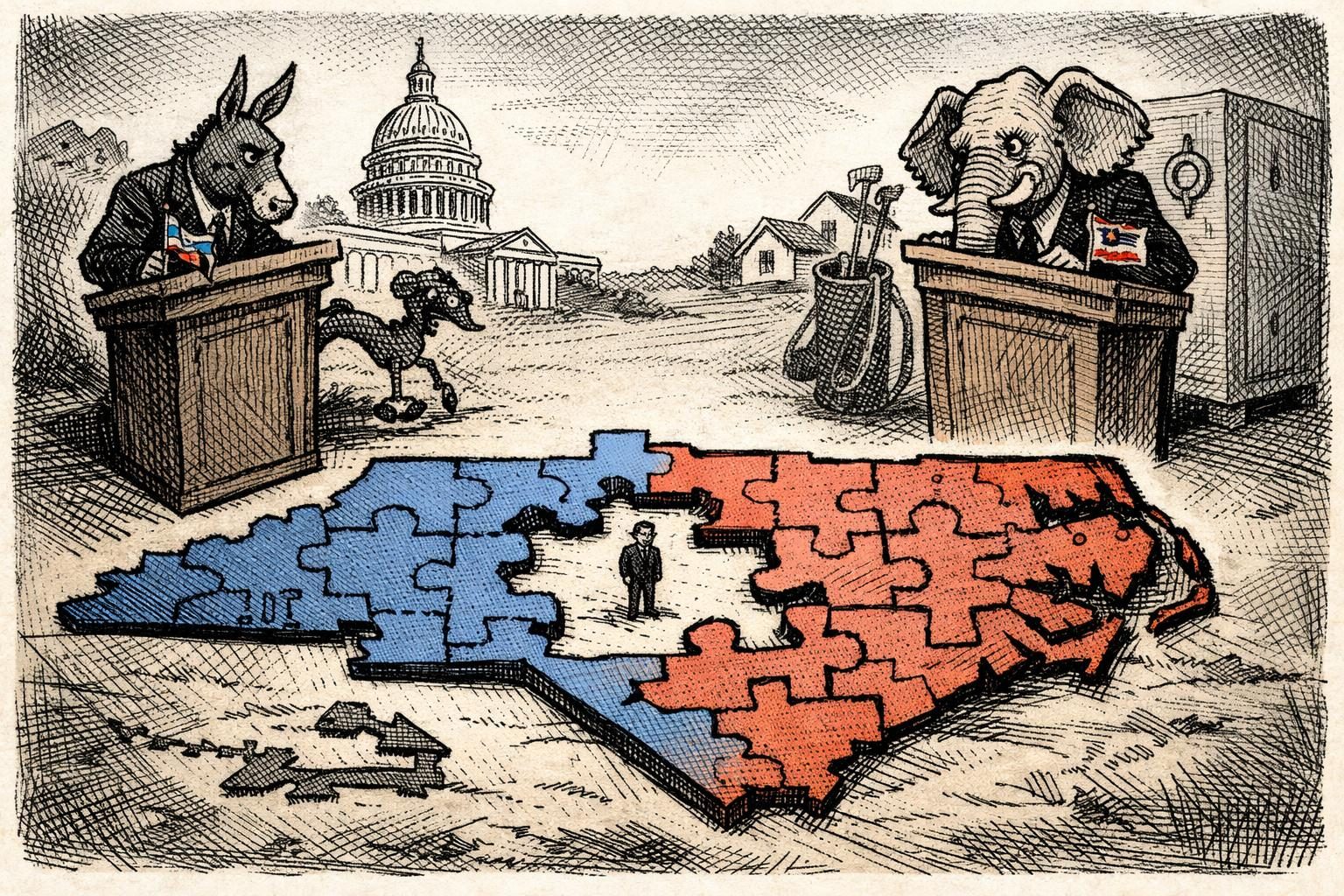
North Carolina’s 13th Congressional District once looked like the kind of seat that could force both parties to compete for the middle. That changed after Republican-controlled mapmaking in the state recast the district into a safer seat for the GOP, a shift that AP says helps explain how the House has become less contestable in places that once were battlegrounds.
The electoral history makes the change visible. Wiley Nickel won the seat narrowly in 2022, when the district still offered more room for cross-party competition. Under the newer map, Brad Knott defeated him comfortably in 2024, underscoring how redistricting can alter not just who wins but how much campaigning a district invites from both parties.
The point of AP’s account is not that one district alone caused Congress’s wider dysfunction. It is that the structure of the map can change the incentives that members face once they are in office. In safer districts, the decisive political threat often comes from a primary rather than a general election, which can push candidates toward the most committed voters in their own party and away from the broad coalition-building that competitive seats tend to reward.
That dynamic is not unique to North Carolina, and it is not limited to Republicans. But AP’s reporting uses the 13th District to show how a Republican-drawn map can feed a national pattern: fewer competitive House seats, less pressure to appeal across party lines, and a chamber that can become more polarized without becoming more effective. The result is a structural critique, not an allegation of a single improper act. The documented facts are the map change, the election outcomes, and the reduced competitiveness they reflect; the judgment that this helps produce a less functional House is the article’s analysis rather than a separately provable metric.
Comments
Read the discussion freely. Posting and voting require a verified member account. Every comment and reply is screened by AI before publication. Clear spam and abuse are blocked; only strongly cleared comments publish automatically, while uncertain drafts wait for moderator review. Civil factual disagreement alone is not grounds for rejection.
Log in to comment or join free to take part.
No comments yet. Be the first reasonably on-topic person here.