
Judge orders Trump officials to halt and undo parts of election order in California-led case
Permanent article number: 102426011 Find another article by number
Original reporting and source documents
Open the reporting and original documents used for this article. These include evidence sources; not every link is necessarily the original claim being examined.
Evidence and accountability
Accountable person, organization or policy: Trump administration defendants in the California election-order case
Documented issue under review: A federal court ordered the administration to stop and reverse implementation of portions of an election executive order as to the plaintiff states, creating an immediate compliance failure risk and contempt exposure.
This report has an independent editorial fact-audit recorded in the archive. Check the linked source documents below for the underlying evidence; where a case remains pending, allegations are not findings.
Questions sent by Radical Reading Room
These requests have a recorded outbound message ID and send time. A request for comment does not establish that its recipient read the message.
U.S. Department of Justice — Public professional press contact
Question: Which specific Trump administration officials other than the president were directed by the judge to halt and undo parts of the voting-related executive order in the plaintiff states?
Contacted: October 25, 2026 at 2:44 PM (server time).
Status: Response pending; no substantive response recorded.
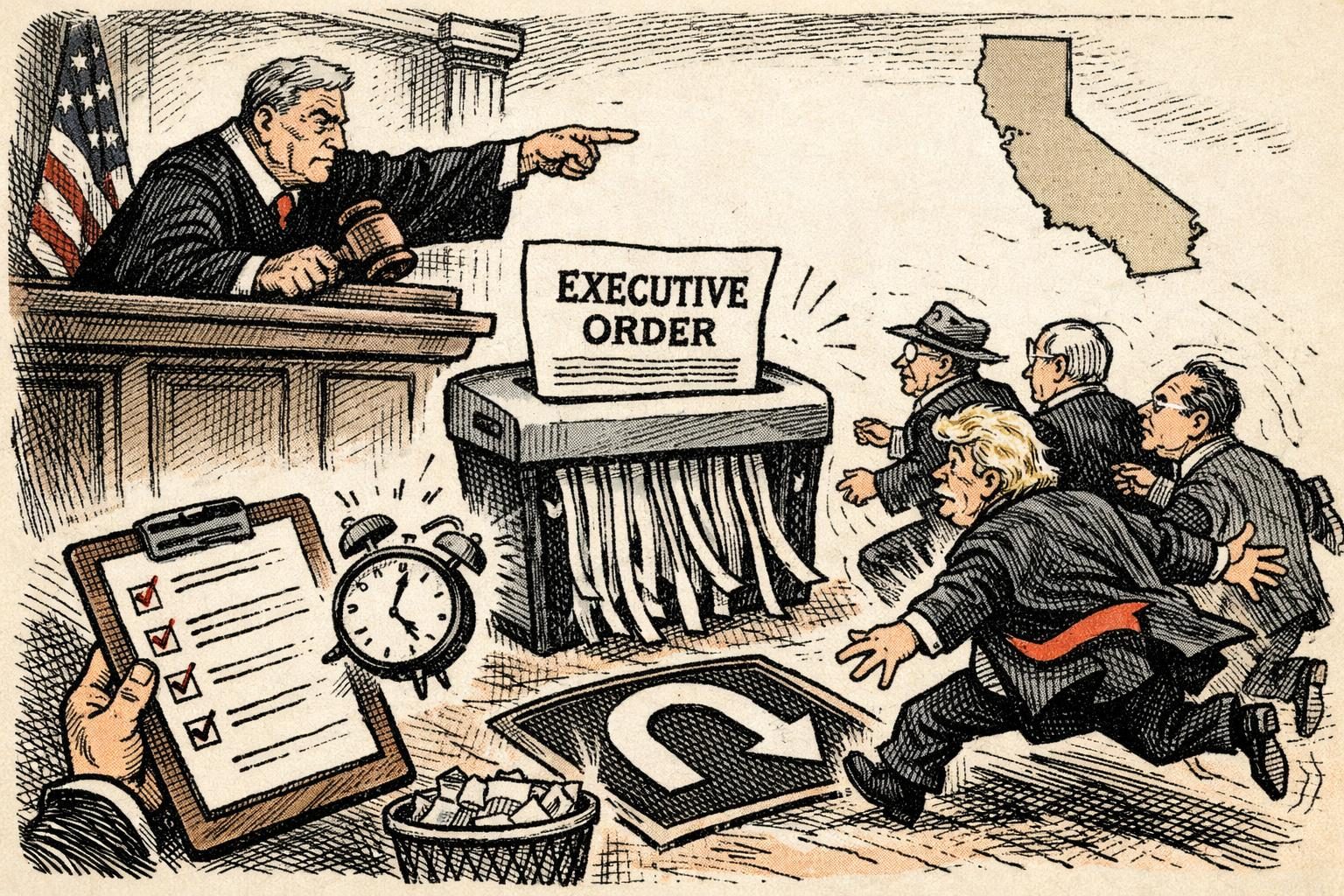
A federal judge in Massachusetts on October 24 ordered Trump administration defendants other than the president to stop carrying out parts of a voting-related executive order in the states that sued, and to unwind implementation already underway. The order in State of California et al. v. Trump et al. also requires notice to affected employees and a status report within seven days. The court’s directive is enforceable and carries the prospect of contempt if officials do not comply.
The new order builds on an earlier ruling from June 25 in which Judge Indira Talwani concluded that Sections 2 and 3 could not be implemented against the plaintiff states, and that Section 5 did not authorize the kind of action the administration had taken. The October 24 order does not reopen that merits decision; instead, it turns the earlier ruling into immediate compliance duties for the defendants covered by the injunction.
What the court ordered is narrower than a final judgment on every issue in the case. It resolves how the defendants must behave while the litigation continues, but it does not by itself settle the larger legal fight over the executive order or establish broader wrongdoing beyond the court’s enforcement findings.
The dispute has unfolded alongside separate Trump administration efforts to investigate alleged noncitizen voting in California. Associated Press reporting this month said federal prosecutors sent letters to county registrars demanding that officials set aside and verify ballots the Justice Department believed might belong to noncitizens. The October 24 order does not resolve that broader conflict, but it does limit what the defendants may do in the plaintiff states while the case moves forward.
Comments
Read the discussion freely. Posting and voting require a verified member account. Every comment and reply is screened by AI before publication. Clear spam and abuse are blocked; only strongly cleared comments publish automatically, while uncertain drafts wait for moderator review. Civil factual disagreement alone is not grounds for rejection.
Log in to comment or join free to take part.
No comments yet. Be the first reasonably on-topic person here.