
Trump’s new Alaska broadside against Murkowski and ranked-choice voting underscores how the Senate race is being nationalized
Permanent article number: 102526016 Find another article by number
Original article being examined
Published by: The Hill
Original reporting and source documents
Open the reporting and original documents used for this article. These include evidence sources; not every link is necessarily the original claim being examined.
Evidence and accountability
Accountable person, organization or policy: Donald Trump and Alaska Republicans
Documented issue under review: Trump is intensifying pressure on Alaska’s election system and on Murkowski, turning a Senate race into a broader fight over ranked-choice voting and party control.
This report has an independent editorial fact-audit recorded in the archive. Check the linked source documents below for the underlying evidence; where a case remains pending, allegations are not findings.
Corrections and clarifications
October 25, 2026: October 25, 2026: Corrected two references describing Donald Trump as a former president. He is the sitting U.S. president in October 2026. The underlying October 24 remarks and sources are unchanged.
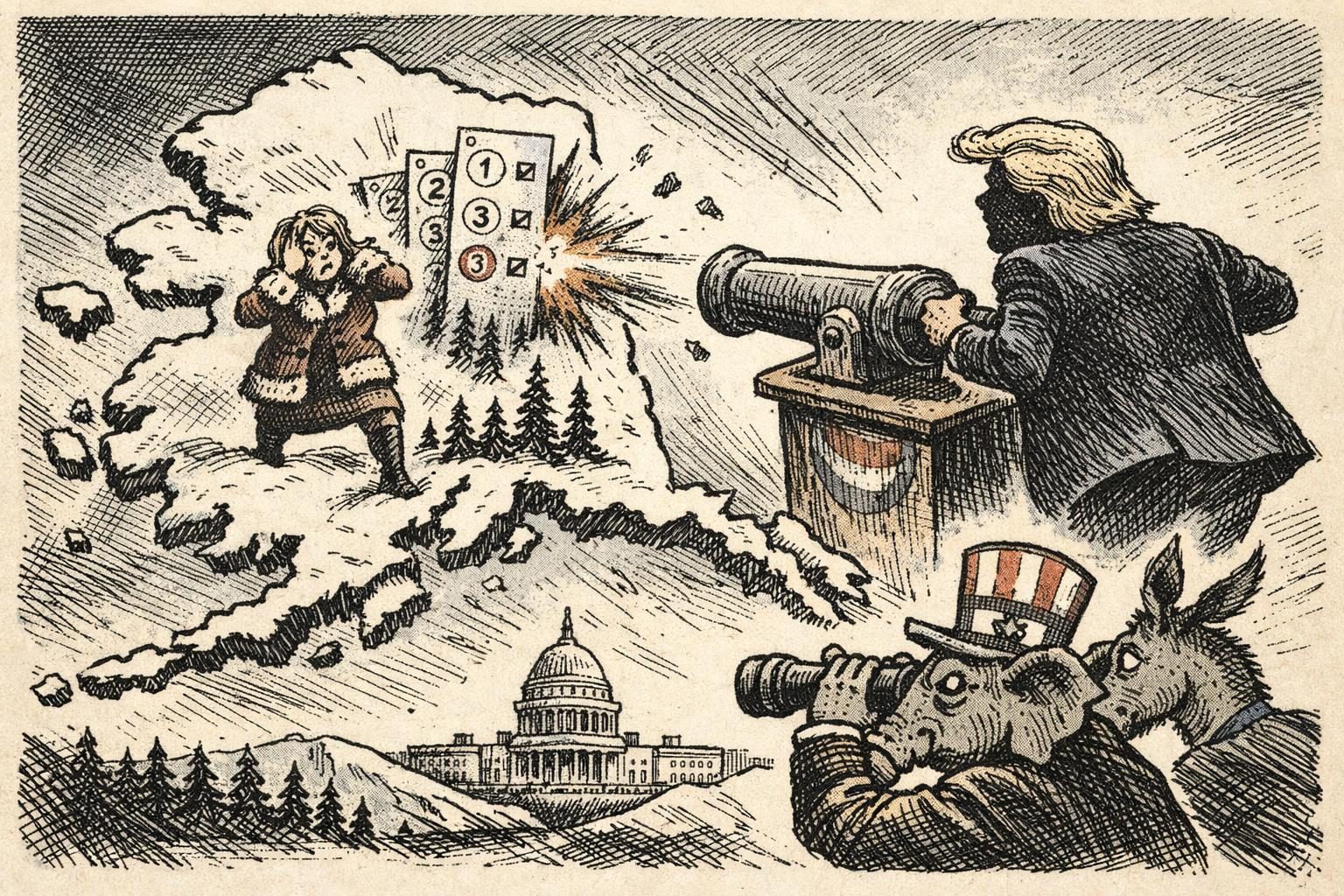
Donald Trump’s latest message from Alaska is less a standalone blast than another sign that the state’s U.S. Senate race is being pulled deeper into the national political bloodstream. On Oct. 24, the president sharpened his criticism of Sen. Lisa Murkowski and once again took aim at ranked-choice voting, a system he has long opposed and one that has become a recurring target for him as Alaska’s political calendar advances. The immediate effect is familiar: a local contest becomes a larger argument about election rules, party loyalty, and the degree to which Republican voters should continue accommodating a senator who has often clashed with the party’s activist base. The broader implication is that Alaska is no longer being discussed only as an isolated Senate battleground. It is being cast, by Trump and his allies, as a test case for whether Republican candidates can win under a system they view as structurally hostile to them. That is not a new political theme, but the timing and repetition give it added force as the race heads toward its final stretch.
The significance of Trump’s renewed focus lies partly in the fact that he remains the most influential figure in Republican messaging, even in states where he is not on the ballot. In Alaska, that influence matters because the party has long been split between institutional pragmatists and voters who prefer a more combative, movement-oriented politics. Murkowski sits at the center of that tension. She is one of the most recognizable Republicans in the state, but she has also repeatedly been a source of frustration for Trump-aligned conservatives, who see her as insufficiently loyal to the president and too willing to depart from the hard-edged party line. By bringing her back into the spotlight, Trump is not merely venting. He is reinforcing a political hierarchy in which loyalty to him remains a defining measure of Republican legitimacy. That has real consequences for how the race is framed, because it encourages voters and activists to treat the Senate contest not only as a choice between candidates, but as a judgment on the party’s internal direction.
Ranked-choice voting is the other piece of the story that makes this more than routine campaign conflict. The system has already become a political symbol well beyond Alaska, and Trump’s criticism helps transform it from a technical election mechanism into a point of emotional and ideological resistance for Republican voters. In practice, ranked-choice voting allows voters to rank candidates in order of preference rather than selecting just one, and supporters describe it as a way to reward broader appeal and reduce spoiler dynamics. Trump and many of his allies, however, frame it as confusing, unfair, or manipulated in ways that disadvantage conservative candidates. That framing may not settle the policy debate, but it is politically potent because it offers a simple explanation for electoral anxiety. When a campaign can connect a procedural system to an outcome it dislikes, it gives frustrated voters a concrete target. In Alaska, that means the election rules themselves are now part of the campaign battlefield, not just the backdrop to it.
The reporting around Trump’s Oct. 24 remarks also underscores how often this race is being treated as a proxy for bigger fights in Republican politics. The Hill’s coverage of the attack highlights how quickly the contest can shift from a normal Senate race into a broader argument about party discipline and the legitimacy of Alaska’s voting system. Separate polling coverage from The Hill’s election tracker has also kept attention on the general shape of the race, reinforcing the sense that Alaska remains an important test of Republican strength. Even without treating the race as a solved puzzle, the combination of polling interest and Trump’s repeated interventions suggests that the contest is being watched nationally for what it says about the party’s future. That is especially true because the Alaska seat has become one of the cycle’s most closely followed Senate fights, and because Murkowski’s political identity has made her a durable symbol of the Republican establishment’s uneasy relationship with the Trump era. Trump’s continued involvement keeps that tension alive and ensures that the race is about more than one senator’s prospects.
The counterargument, of course, is that campaigns routinely attack the rules when they think the rules work against them, and Trump’s comments may simply reflect a predictable political move rather than something uniquely consequential. That is true as far as it goes. But in this case, the messenger matters as much as the message. Trump’s ability to elevate a grievance changes the scale of the dispute and gives it staying power in a race that might otherwise be discussed in narrower terms. It also puts pressure on Republican candidates and operatives in Alaska to decide whether to embrace the anti-ranked-choice message fully or try to keep the focus on traditional campaign issues such as turnout, candidate credibility, and general election arithmetic. That choice matters because the more the party leans into Trump’s framing, the more the race becomes nationalized around his political brand and his longstanding conflicts with Murkowski. The result is a Senate contest that is increasingly a referendum not just on who will represent Alaska, but on what kind of Republican politics will define the state going forward.
Comments
Read the discussion freely. Posting and voting require a verified member account. Every comment and reply is screened by AI before publication. Clear spam and abuse are blocked; only strongly cleared comments publish automatically, while uncertain drafts wait for moderator review. Civil factual disagreement alone is not grounds for rejection.
Log in to comment or join free to take part.
No comments yet. Be the first reasonably on-topic person here.