
Judges signal skepticism in Trump DOJ’s California voter-roll fight
Permanent article number: 102626003 Find another article by number
Original reporting and source documents
Open the reporting and original documents used for this article. These include evidence sources; not every link is necessarily the original claim being examined.
Evidence and accountability
Accountable person, organization or policy: Trump administration and Justice Department
Documented issue under review: The administration is pressing an aggressive election-law theory that drew skepticism from the appeals court and raises questions about federal overreach into state election administration.
This report has an independent editorial fact-audit recorded in the archive. Check the linked source documents below for the underlying evidence; where a case remains pending, allegations are not findings.
Questions sent by Radical Reading Room
These requests have a recorded outbound message ID and send time. A request for comment does not establish that its recipient read the message.
U.S. Department of Justice — Public professional press contact
Question: What specific criteria and evidence did the Justice Department use to identify the approximately 20,000 flagged voter registrations as likely belonging to noncitizens?
Contacted: October 26, 2026 at 6:14 AM (server time).
Status: Response pending; no substantive response recorded.
Corrections and clarifications
October 26, 2026: Source-link and source-publication-date correction: Reuters' actual original article was published October 25, 2026. Its linked URL and original-source publication-date metadata were corrected; the October 25 event date and the article's substantive reporting did not change.
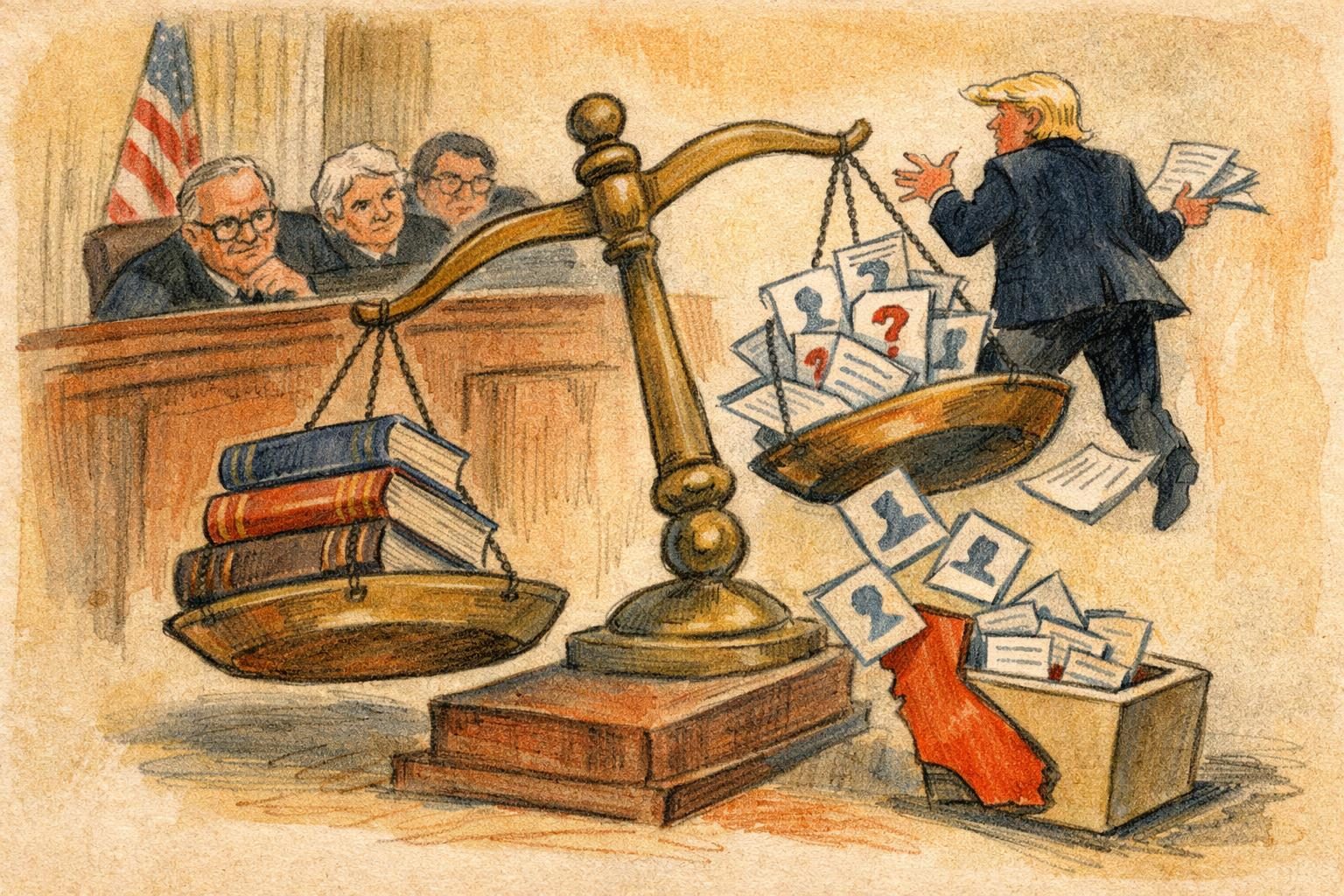
A federal appeals court hearing on October 25 put the Trump administration’s California voter-roll lawsuit under sharp scrutiny, but it did not produce a final ruling. Judges on the Ninth Circuit pressed the Justice Department on why the federal government should be granted emergency relief in a dispute over how California handles registrations the administration has flagged as likely noncitizens. The hearing itself was procedural, yet the questioning suggested the panel had serious reservations about the government’s theory.
At the center of the case is the Justice Department’s request that California review about 20,000 names the federal government says appear to match likely noncitizen registrations. That is the relief the administration is seeking; it is not a court finding or an order already in effect. Reuters and AP both reported that the judges’ questions focused on whether the federal government had shown enough to justify urgent court intervention in a matter that ordinarily sits largely within state election administration.
The distinction matters because the hearing was about procedure and legal authority, not a merits decision on whether the flagged registrations are invalid. California officials remain in charge of the state’s election machinery unless and until a court orders otherwise. The administration’s position is that federal courts should step in quickly; the apparent pushback from the panel suggests that argument faces a difficult path, at least on the record aired Sunday.
The dispute also reflects a broader fight over who controls election enforcement when Washington and Sacramento disagree. The Justice Department has framed the matter as a ballot-integrity issue, while the hearing raised the opposite concern: whether the federal government is asking a court to intrude too far into state-run election administration. That question was not resolved on October 25, but it appeared to dominate the panel’s attention.
For now, the immediate consequence is uncertainty rather than a verdict. The court has not ordered California to take the steps the administration seeks, and the hearing did not settle whether the federal lawsuit can meet the standard for emergency relief. What it did show was that the panel wanted a more substantial explanation before approving a request that could reshape how the state responds to the flagged registrations.
Comments
Read the discussion freely. Posting and voting require a verified member account. Every comment and reply is screened by AI before publication. Clear spam and abuse are blocked; only strongly cleared comments publish automatically, while uncertain drafts wait for moderator review. Civil factual disagreement alone is not grounds for rejection.
Log in to comment or join free to take part.
No comments yet. Be the first reasonably on-topic person here.