
Trump renews push to replace ‘AI’ with ‘super intelligence’ after criticizing the Wall Street Journal
Permanent article number: 102726035 Find another article by number
Original article being examined
Published by: Just the News
Trump complains WSJ won't use 'super intelligence' for AI — Read the exact original
Claim examined: Trump complained that the Wall Street Journal would not call artificial intelligence by his preferred name, 'super intelligence' or 'SI,' and said he would soon ban the term 'AI' in relevant documents.
Original reporting and source documents
Open the reporting and original documents used for this article. These include evidence sources; not every link is necessarily the original claim being examined.
Evidence and accountability
Archive transparency: this article has not yet completed the site's newer independent fact-audit process. Its source links are provided below. Do not treat allegations, commentary, or a rating as a legal finding.
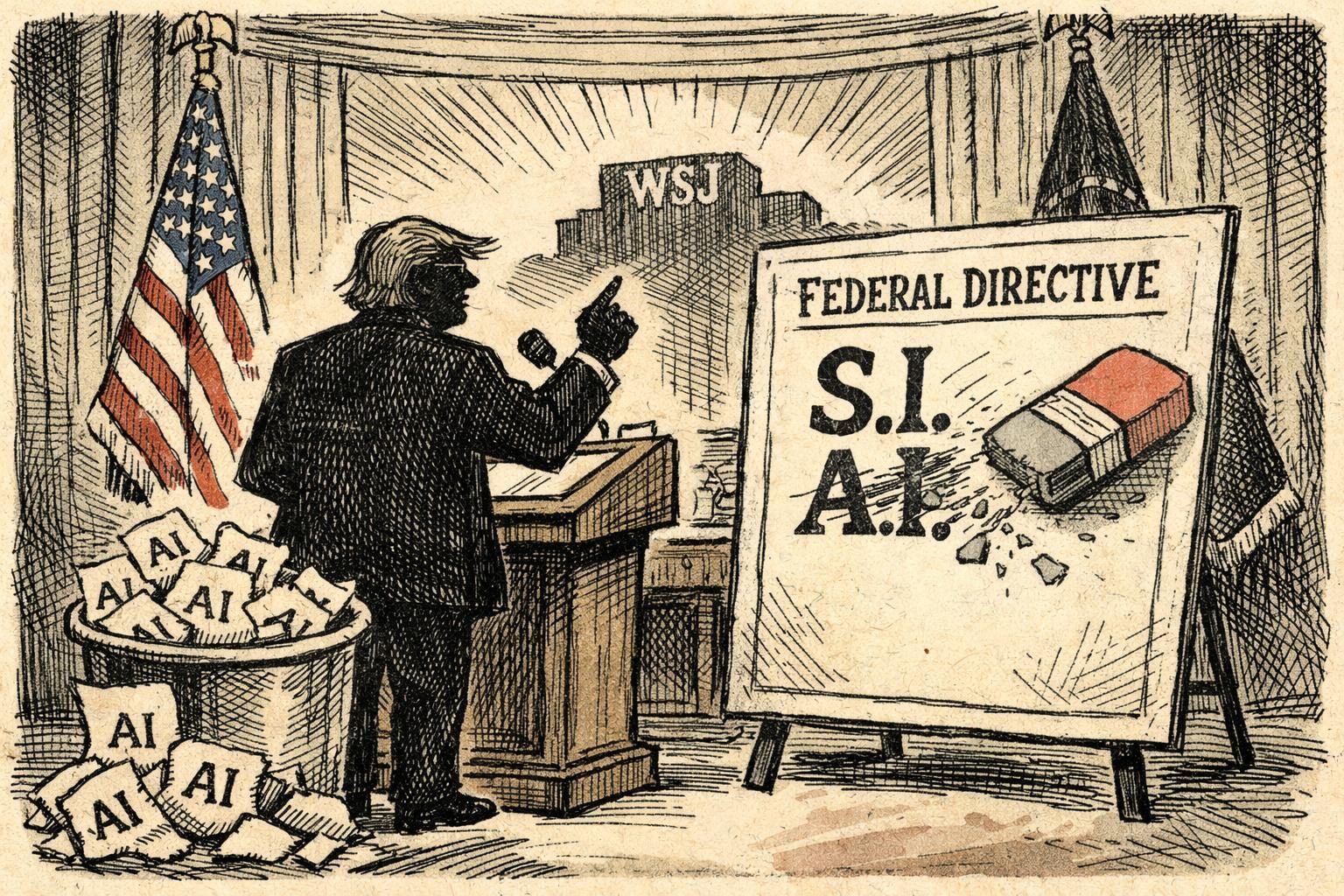
President Donald Trump on October 27, 2026, used Truth Social to revive his campaign to replace the term “artificial intelligence” with “super intelligence,” or “SI,” while singling out the Wall Street Journal for not adopting his preferred terminology. In the post, Trump complained that the paper had not started calling AI by the new name and said he would soon ban the older term in relevant federal documents and other materials. Reuters reported the same message on October 27, and the White House’s September 29 fact sheet and executive order show that the rename effort is not a one-off joke: the administration formally directed federal agencies to use “Super Intelligence” and “SI” in official non-statutory communications. ([marketscreener.com](https://www.marketscreener.com/news/trump-says-he-will-ban-term-artificial-intelligence-ce785cdddf8bf626?utm_source=openai))
The original record for the policy change is Executive Order 14434, signed September 29, 2026 and published in the Federal Register on October 2, 2026. The order states that agencies should use “Super Intelligence” and “SI” in official correspondence, public communications, websites, reports, policy documents, and other non-statutory documents within the executive branch. That matters because it turns the renaming from a campaign-style flourish into an administrative directive with at least some federal reach. The White House fact sheet describes the move as part of inaugurating “the era of super intelligence.” ([whitehouse.gov](https://www.whitehouse.gov/wp-content/uploads/2026/09/eo-14434.pdf?utm_source=openai))
Independent reporting also shows the terminology shift had already begun before Trump’s October 27 complaint. Roll Call’s Factba.se transcript records Trump saying on September 29 that the administration had “officially” changed the name to SI. Nextgov/FCW likewise reported that the White House issued the executive order and said agencies must use the new term in official materials. Those accounts help confirm that the Wall Street Journal criticism was not the origin of the policy, but a new public push to normalize it. ([rollcall.com](https://rollcall.com/factbase/trump/transcript/donald-trump-press-gaggle-after-ai-luncheon-the-sticks-september-29-2026/?utm_source=openai))
The competing interpretation is straightforward: supporters may see the rename as a branding move meant to emphasize ambition, while critics can reasonably view it as terminology imposed from the top that has little technical consensus behind it. The sources reviewed do not show broad adoption outside government, and they do not show any immediate legal penalty for private publishers that continue using AI. They do show, however, that the administration is trying to make the new term stick through official guidance and repeated presidential messaging. ([whitehouse.gov](https://www.whitehouse.gov/fact-sheets/2026/09/fact-sheet-president-donald-j-trump-inaugurates-the-era-of-super-intelligence/?trk=public_post_comment-text&utm_source=openai))
What is known is that Trump made the complaint on October 27, 2026 and tied it to a real executive-order campaign that began on September 29. What is not known from the sourced material is whether the administration will meaningfully enforce the proposed ban in practice, how widely federal agencies will comply over time, or whether private-sector and media usage will shift beyond symbolic alignment. For now, the episode is best understood as a documented messaging and administrative branding effort, not as evidence of a new completed policy regime. ([marketscreener.com](https://www.marketscreener.com/news/trump-says-he-will-ban-term-artificial-intelligence-ce785cdddf8bf626?utm_source=openai))
Comments
Read the discussion freely. Posting and voting require a verified member account. Every comment and reply is screened by AI before publication. Clear spam and abuse are blocked; only strongly cleared comments publish automatically, while uncertain drafts wait for moderator review. Civil factual disagreement alone is not grounds for rejection.
Log in to comment or join free to take part.
No comments yet. Be the first reasonably on-topic person here.